Mike Birbiglia, April Ludgate, and the Upsetting Social Pressure to Make a Family

Mike Birbiglia betrayed us.

Mike Birbiglia’s 2013 stand-up special My Girlfriend’s Boyfriend begins with a targeted critique of marriage:

So about five years ago, pretty much everyone who I know started to get married, and that was strange for me because I don’t really believe in the idea of marriage. And that would have been fine, except I have a problem where sometimes when I think that I am right about something, it can be a real source of tension between me and the person I’m arguing with. And the reason it’s a source of tension is that I’m right. And so I remember distinctly talking to my friend Dana, and she goes, “Well, you don’t believe in marriage for you, but, of course, you believe in it for other people.” And I was like, “No, I think it’s insane, you know, for anyone.” And she said, “Why?” And I said, “Well, first of all, it just seems doomed.” You know, 50% of marriages end in divorce. That’s just first marriages, by the way. Second marriages, 60% to 62% end in divorce. Third marriages, 70% to 75% end in divorce. That’s a learning curve.

And he doesn’t stop there. In his comedy special, This American Life and The Moth regular Mike Birbiglia reinforces his anti-marriage worldview with jokes about actively resisting the pending marriages of his friends:

I had one ally in all this, which is my friend Andy, and he’s a comedian as well. Not only did we decide we weren’t gonna get married, we actually tried to stop other people we knew from getting married. Yeah, we were pretty good at it. Like, we stopped or put on hold three or four marriages, you know. We were pretty good. I mean, we weren’t like the best in the world. I’m sure there are better in Europe. But we were solid, you know. Like, so, like, for example, at point my friend Alex was about to get engaged. And so we just took him to dinner. And during dessert, we gave him a long, hard stare. We said, “Are you sure this is what you want to do?” And then we went cold to give him the sense of what it would feel like when we weren’t friends anymore.

Throughout his special, Billions and Orange Is the New Black guest star Mike Birbiglia critiques the gaudiness of marriage ceremonies (“I don’t buy into the flamboyant pageantry that goes into celebrating it”), the history of marriage (“marriage is an archaic institution invented in the middle ages based on exchanging property”), the legal mores of marriage (“why does it need to be written into a government contract?”), and marriage’s inherent connections to religion (“I’ve been to more weddings of my friends where the people on the altar don’t believe in the religion of the church they’ve invited us to!”).

Then, Cedar Rapids (2011) and Trainwreck (2015) actor Mike Birbiglia tells a personal story about the comically tragic aftermath of a car accident—a story he has told on This American Life and elsewhere—before transitioning back to his girlfriend Jenny: “The only person who would talk to me at this point was Jenny.”

Famous sleepwalker Mike Birbiglia ends his 2013 special with a heartwarming admission of his own stubbornness and a confession of his marriage to poet Jen “Jenny” Stein:

July 7, 2007, Jenny and I went to city hall and got married. I still didn’t believe in the idea of marriage, and I still don’t. But I believe in her, and I’ve given up on the idea of being right.

It’s sweet.

But I hate it. I hate it because it doesn’t stop there.

At the beginning of his 2019 comedy special The New One, casual Taylor Swift friend Mike Birbiglia acknowledges his dislike of children:

Maybe I have a low tolerance for children. I’ve lost a lot of great friends to kids. Because it really is like a disease in some ways. But it’s worse than a disease because they want you to have it too. [zombie voice] “You should have kids too.” I’m watching you do it, and I’m thinkin’ I’m gonna not do it. They’re like zombies, they’re like [zombie voice] “You should eat brains.” I’m watching you eat brains, and it seems like it ruined your life.

By his own admission, past Late Night with Conan O’Brien intern Mike Birbiglia’s desire for a childless life was unambiguous: “I was very clear when we got married that I never wanted to have a kid. . . . I was clear I would never change.”

And throughout The New One, he offers specific reasons for not wanting kids:

Number one, I’ve never felt like there should be more of me in the world. . . . I had cancer, life-threatening sleeping disorder, Lyme disease, diabetes. I’m not exactly handing off A-plus genes here. Number two. I love my marriage, and I feel…I really do, I feel so lucky to have found my wife. . . . And I don’t want to give that up. I don’t want that to change. I don’t want a third person showing up, like, “What about me?” I’m like, “We don’t even know you!” Number three. I don’t know anything and I’m not ready to teach the children. I mean, I’ve read hundreds of books. I’ve retained very little. . . . Number four, I have a cat. Number five. I have a job. . . . It took me a long time to figure out anything I was good at. I wasn’t good at video games, or archery, or whatever the hell kids do. And then, I figured this out. I don’t want to give that up. My brother’s like, “Mike, you can have a kid and a career.” And I said, “Yeah, Joe, but it’ll be worse.” If we’re being honest with ourselves kids hold us back. . . . Number six. I don’t think there should be children anymore. Nothing drastic. I think the current children can see through their term. I just think maybe we cut it off there, because, look, we were given the earth and we failed. . . . Number seven. People aren’t great. Not just Nazis. I mean, people in general are not great. And look, you guys seem fine. And the conventional wisdom is that people are generally good. But are they?

And Jimmy Kimmel Live fill-in Mike Birbiglia allegedly told his wife all of that: “Why would you want to bring a child into this world with me? I’m a walking pre-existing condition, the earth is sinking into the ocean, we’re about to be living in the movie Waterworld, which did terribly at the box office. People are horrible, and I’m not great.”

His wife allegedly responded, “I know all of that. And I think you’d be a good dad.”

So they had a kid. Not just in the comedy special anecdote. Real-life married father Mike Birbiglia actually has a child now.

Mike Birbiglia betrayed us.

I want to be abundantly clear: The problem is not that Birbiglia is married and has a child. Unlike Birbiglia in his own stand-up special, I do not mind when others get married or have children. The problem is that Birbiglia publicly and enthusiastically advocated for single, childless lifestyles before getting married and having a child—and then uses his past advocacy as fodder for comedy.

Consider the current socio-political landscape as it applies to perceptions of marriage, parenting, and “traditional” families:

  • In 2015, Pope Francis said that couples who choose not to have children are “selfish.” Pope Francis reinforced that belief again in 2024, praising cultures with averages of three to five children per household: “Keep going like this. It is an example for all countries.”
  • In 2016, Bella DePaulo, Ph.D., explained the inherent psychological biases we have against single individuals: “Nearly every other person describing married people, approximately 49 percent, spontaneously suggested that married people are kind, caring, or giving. Only 2 percent of the participants describing single people came up with those same characteristics. Every third person describing married people, around 32 percent, said that they were loving. No one—not one person—described single people this way. Married people were also more often described as happy, secure, loyal, compromising, and reliable. Single people, though, were more often described as independent.”
  • In 2021, JD Vance criticized “childless cat ladies,” which according to to NPR is an insult with a long history designed to paint childless women as either frightening or pitiful. (Vance has since claimed that his comment was meant as a critique of the “anti-family and anti-child” Democratic Party.)
  • Also in 2021, JD Vance stated that the idea of childless educators having influence over children “disorients” and “really disturbs” him. (Again, Vance later reframed his comment as a critique of “left-wing indoctrination” in schools.)
  • Again in 2021, JD Vance wondered during an interview whether or not childlessness might make people “people more sociopathic and ultimately our whole country a little bit less mentally stable.” The full quote: “There’s just these basic cadences of life I think are really powerful and really valuable when you have kids in your life, and the fact that so many people, especially in America’s leadership class, just don’t have that in their lives, you know — I worry that it makes people more sociopathic and ultimately our whole country a little bit less mentally stable.”
  • In 2022, a survey showed that “52% of 1,000 single UK adults reported experiencing single shaming ‘since the start of the pandemic.'” According to BBC, “researchers asked about the common ‘shaming phrases’ single people have heard from others, and 35% said they were told ‘you’ll find someone soon’. Twenty-nine percent heard ‘you must be so lonely’, while 38% reported general pity over their relationship status.”
  • A 2024 study from the Personality and Social Psychology Bulletin, unveiled “four overlapping ‘archetypes’ [perceptions] of single women and men”, including “‘Heartless (‘selfish,’ ‘promiscuous’), and Loner (‘lonely,’ ‘antisocial’).”

So when folks like Mike Birbiglia softly belittle genuine concerns about marriage and procreating, they are perpetuating a longstanding and wholly damaging status quo of pro-marriage, pro-procreating propaganda. In his comedy specials, Birbiglia presents himself as an underdog who reluctantly succumbs to happiness, but he’s really just punching down. He creates a fun, quirky, freethinking single-life caricature of himself only so that he can later use self-deprecation as a means of discounting singleness and/or childlessness.

Mike Birbiglia is not the only one who does this. My least favorite scene in the entire run of Parks and Recreation is this one:

Like Birbiglia, April Ludgate had valid reservations about having a child. But then Andy, Ben, and Leslie effectively bully April into having children. And so she does. (Leslie tells April that she likes her “team” and would love to see more “team members,” whatever that means.)

In the episode, Ben’s assertion that April will inevitably “get there” and change her views about children is particularly heinous.

There are valid reasons to oppose marriage and/or a child-filled lifestyle. According to 2025 numbers from Forbes, 43% of first marriages end in divorce. Yes, that’s lower than the commonly spread divorce statistic of 50%, but a 57% success rate is still hardly worth celebrating. If a restaurant had a 57% satisfaction rate, would you make a reservation? If a university had a 57% job placement rate, would you pay tuition? The average wedding in 2023 cost $30,119, and the cost of raising one child is, on average, $21,681 per year, not including the cost of saving for college. (The cost of raising a child over 18 years is $237,482 “just for the basic necessities”). Plus, the idea of marriage as an act of love is relatively new. Marriage was “rarely a matter of free choice” until the late 20th century. For most of human history, “romantic love was not the primary motive for matrimony.”

Finally, there’s nothing selfless about having children, unless you can somehow guarantee that your kid is going to cure cancer or be the first interstellar pioneer to colonize another solar system. Otherwise, you’re having a kid for you—because you want a child. This is perfectly fine, but let’s be honest about it.

Even if someone does not have “valid” reasons for being hesitant about (or outright opposing) marriage and procreation, you should still respect those views without comment or objection. The validity of the worldview is not the point: the hesitation itself is the point. Many in society—pastors, parents, purveyors of the patriarchy—proselytize endlessly about the importance of the bonds of marriage and the roles of parenthood. So shouldn’t folks think long and hard about whether or not they want to enter into those commitments? Shouldn’t that hesitation be celebrated, not belittled? But, instead, many treat having children like buying lottery tickets: lots of uninformed finger-crossing (with plenty of awkward scratching and dirty fingernails, I assume).

Luckily, there are some positive, confident portrayals of singleness and/or childlessness in films and on television. Mary Albright from 3rd Rock from the Sun. Commander Adama from Battlestar Galactica. Mackenzie McHale from The Newsroom. Poppy Li from Mythic Quest (before the fourth season). Kenneth Parcel from 30 Rock. Elise Atchison, Brenda Cushman, and Annie Paradis from The First Wives Club. And pretty much every single superhero from both Marvel and DC.

But I’ll leave you with one of my favorite portrayals of a confident, single, and childless character—which, incidentally, comes from Parks and Recreation. Not early-seasons April Ludgate or Leslie Knope. I’m talking about Jennifer Barkley.

Yes, I know that the character of Jennifer Barkley reinforces the “heartless” stereotype of the single, childless individual and is a less-than-perfect symbol of my argument. But I can’t resist the comparison: In a world utterly filled with Leslie Knopes and April Ludgates, be bold enough to be a Jennifer Barkley.


Ben Boruff is a co-founder of Big B and Mo’ Money. Read more at BenBoruff.com.

An Analysis of All Visual Media I Experienced for the First Time in 2024

I think about the end of The Cable Guy a lot.

The Cable Guy is a 1996 dark comedy about an unstable cable installer played by Jim Carrey. As a kid, I didn’t think much of the movie. I felt claustrophobic watching it. Directed by Ben Stiller and produced by Judd Apatow, The Cable Guy showcases the psyche of a guy who refuses to respect his new friend’s personal space. It’s like What About Bob? (1991) with violence and a trip to Medieval Times. Or like Alfonso Cuarón’s Gravity (2013) if you replaced the deadly emptiness of space with uncountable copies of your most annoying friend.

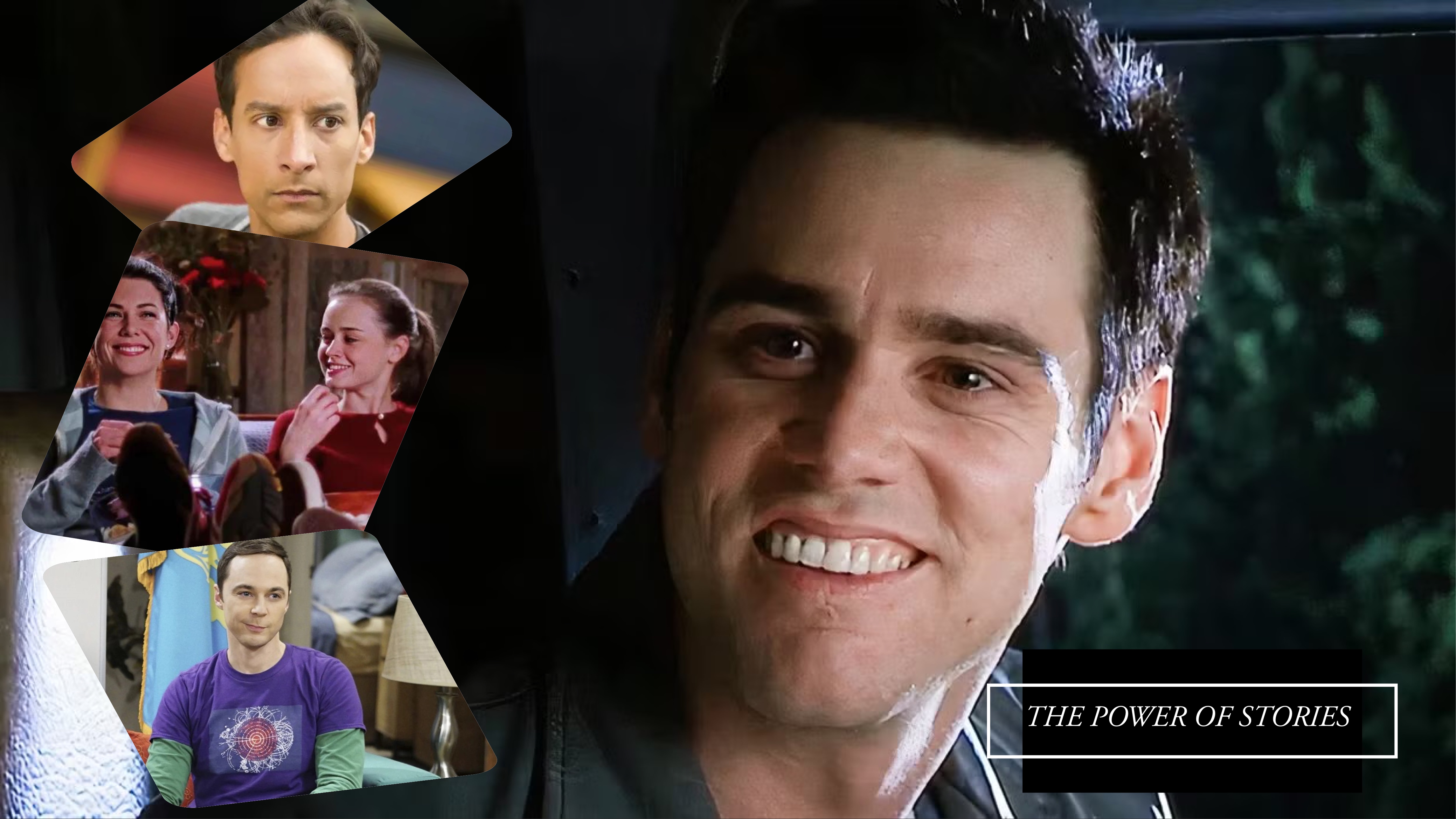
But it’s also more than that. The Cable Guy is an examination of our relationships with media. Like Community‘s Abed Nadir, Gilmore Girls‘s Lorelai Gilmore, and The Big Bang Theory‘s Sheldon Cooper, the Cable Guy processes his world through the lens of visual storytelling—i.e. movies, television shows, and video games. Stories aren’t just stories. They’re a roadmap for interacting with others in real life.

At the film’s climactic moment, the Cable Guy holds his friend Steven’s girlfriend hostage at the top of a massive satellite dish. When Steven tries to intervene, the Cable Guy smiles and says, “This is a pretty cool place for an ending . . . It’s like that movie Goldeneye.”

Steven yells back, exasperated, “No, it’s not! It’s not ‘like’ anything! This isn’t a movie. This is reality. There’s a difference!”

Then, silhouetted by the bright lights of a police helicopter and standing at the edge of the multi-story satellite dish, the Cable Guy looks up and yells to the sky:

You were never there for me, were you mother? You expected Mike and Carol Brady to raise me! I’m the bastard son of Claire Huxtable! I am a lost Cunningham! I learned the facts of life from watching The Facts of Life! Oh, God!

Later, in an interview, Jim Carrey noted that The Cable Guy was one of his favorite films and expressed special fondness for the protagonist: “I love that character. That character is all of us: we were all raised by the TV.”

To be clear, none of us should scream about The Brady Bunch on the top of a satellite dish (unless that’s your thing). But there is something compelling about the story of a man who leaned a bit too far into his television-fueled fantasies. Because I think Jim Carrey was right, sort of. With the rise of streaming and the explosion of online content, The Cable Guy‘s message is more relevant now than it was in 1996. Parasocial relationships are common now, and several studies have revealed links between media consumption and perceptions of others. You may not actively think of film scenes when making moral decisions, but research shows that the films and media you watch impact skills like empathy and problem-solving.

I was reminded recently that there is no such thing as mindless scrolling or viewing. Our brains absorb everything we put in front of our eyes, even if it happens in ways we don’t comprehend. So it makes sense that we should analyze the types of media we experience. If the movies and shows I watch impact my perception of the world, I should examine which movies and shows I experience.

Below is an analysis of every movie, television show, video game, and feature-length YouTube video I experienced for the first time in 2024. The data is first, then an analysis, and then a comprehensive list of everything I experienced.

The Data

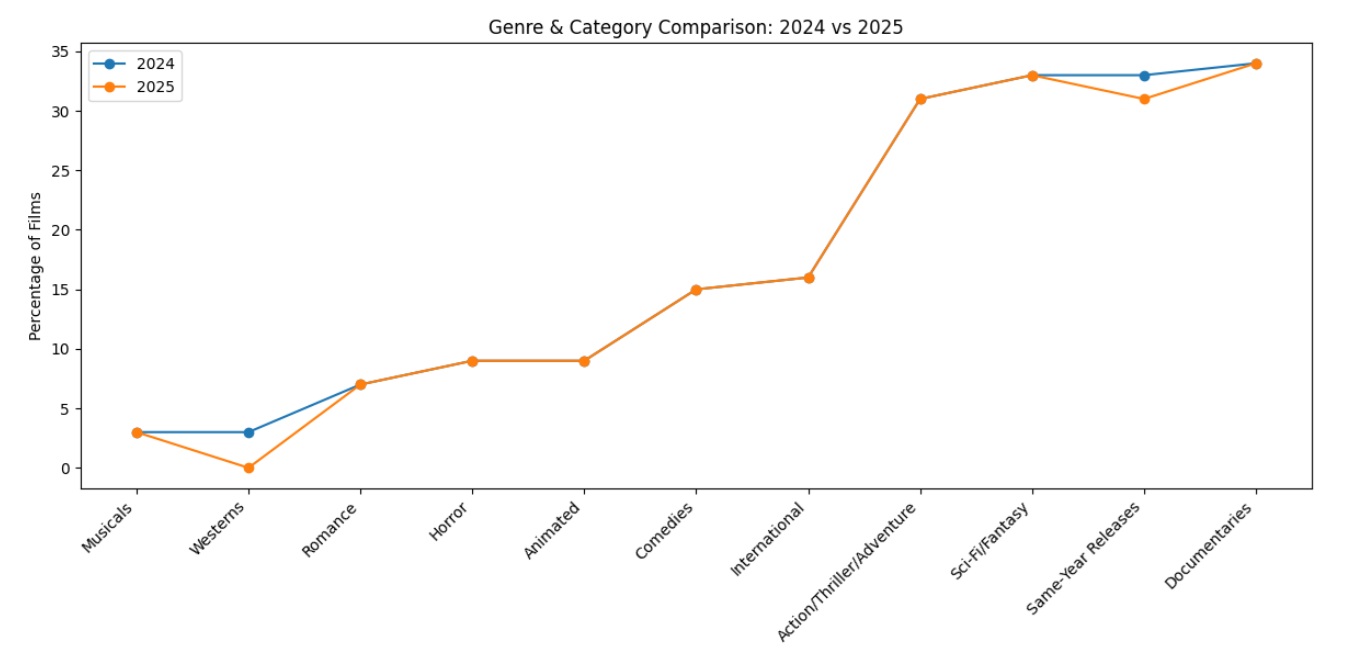
Of the films I watched for the first time in 2024:

  • 3% are musicals
  • 3% are Westerns
  • 7% are romance films
  • 9% are horror films
  • 9% are animated films
  • 15% are comedies
  • 16% are international (primarily non-US) films
  • 31% are action, thriller, or adventure films
  • 33% are science fiction or fantasy films
  • 33% are films that released in 2024
  • 34% are documentaries
  • 45% feature women protagonists and/or women-driven stories (though only 27% were directed by women)

Of the television show seasons I watched for the first time in 2024:

  • 12% are historical dramas or comedies
  • 16% are reality television shows
  • 27% are animated shows
  • 39% are comedies
  • 40% are science fiction or fantasy shows
  • 47% are dramas (not reality television)
  • 65% feature women protagonists

Analysis

Documentary Film Explosion: In 2019, only 12% of the films I watched were documentaries. In 2018, only 6% were documentaries. In 2024, an impressive 34% of the films I watched for the first time were documentaries. I am not entirely sure why documentary films clicked with me in 2024. Perhaps the increase is the result of a newly fueled desire to remain emotionally and intellectually tethered to the very real and very chaotic happenings on this planet. Perhaps my rate of documentary consumption mirrored my increased interest in podcasts about real-life topics. (I recommend Devil in the Dorm, The Retrievals, The King Road Killings, and White Devil.) Perhaps Brian Cox’s speech from Adaptation (2002) finally sunk in. Whatever the reason, I’m proud of the increased number of documentary films. Surely, there is value in exploring real-life stories. Of all the documentaries I watched this year, these seven stand out: Ballerina (2016), The Waiting Room (2012), The Truth vs. Alex Jones (2024), The Greatest Night in Pop (2024), Bad Faith (2024), Skywalkers: A Love Story (2024), and Cirque du Soleil: Without a Net (2022).

Need for International Films and Non-Male Directors: Most years, my international film exposure plateaus at 15-20%, and 2024 was no exception. Additionally, only 27% of the films I watched were directed by women. Both pieces of data highlight areas of needed improvement. My 2024 movie-watching experience was primarily U.S.-centric and directed by men. Though my percentage of women-directed films (27%) is higher than some national trends—”women accounted for just 16% of directors working on the 250 highest-grossing domestic releases” in 2024, according to Variety—this is nonetheless a percentage that I aim to increase in the future. And I would love to break beyond 20% for international releases in 2025. The good news: according to Axios, “Americans are consuming more foreign content than ever.” I hope this trend continues.

Planting Seeds of Horror, History, and the West: Though horror (9%) and Western (3%) films did not dominate my 2024 movie-viewing experiences, I did watch more than previous years. (I watched notably fewer animated films—just 9%—than previous years. In 2019, animated films were at 16%.) And 12% of my new television show experiences were from the historical fiction genre. This is a mild departure from my usually tunnel-visioned focus on science fiction and fantasy. In 2019, 40% of the films I watched for the first time were science fiction, fantasy, or apocalyptic movies. In 2018, that number was 45%. In 2024, only 33% of the films I watched for the first time were science fiction or fantasy films. Science fiction and fantasy remain my favorite genres, but I find myself branching out more recently, which is exciting. The fact that I watched more documentary films (34%) than science fiction and/or fantasy films (33%) for the first time in 2024 is notably bonkers. I don’t imagine I will ever become a true horror aficionado, but it’s nice to know that my interests are still evolving. And the Western films I watched—particularly Unforgiven (1992), The Quick and the Dead (1995), and The Ballad of Lefty Brown (2017)—were some of my favorite new experiences. Plus, I absolutely loved the historical television dramas Black Sails and Victoria.

Other Observations and Subjective Awards
Movies

Movies I finally watched after years of neglect: Mission: Impossible (1996), Lilo & Stitch (2002), Army of Darkness (1992), and Unforgiven (1992)

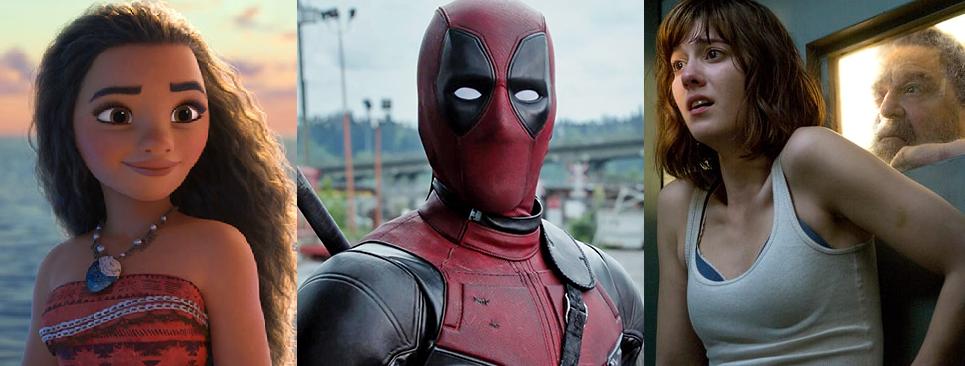
Favorite movies released in 2024: It’s What’s Inside, Dune: Part Two, Bad Faith, and Suncoast

Favorite pre-2024 films I watched: Bones and All (2022), John Wick: Chapter 4 (2023), Theater Camp (2023), Anatomy of a Fall (2023), Molli and Max in the Future (2023), Ballerina (2016), The Waiting Room (2012), and Unforgiven (1992)

Film maudit (films “unfairly maligned” by critics): Joker: Folie à Deux (2024) and Trap (2024)

Movies I started with no expectations and found surprisingly good: Hellraiser (2022), Skywalkers: A Love Story (2024), Abigail (2024), and The Wheel (2021).

Movies I started with mid-to-high expectations and found notably disappointing: The Sunset Limited (2011), Queenpins (2021), and Wild Wild Space (2024).

Worst movies watched in 2024: We’re All Going to the World’s Fair (2021), Gentlemen Broncos (2009), Fall (1997), They Called Him Mostly Harmless (2024), Borderlands (2024), and My Old School (2022).

Television Shows

Favorite shows and seasons: Twilight of the Gods (S1), Dune: Prophecy (S1), Black Sails (S1, S2, S3, S4), Hazbin Hotel (S1), Industry (S3), Peacemaker (S1), Fallout (S1), and Survivor (S26).

Seasons that were almost brilliant but not quite there: The Decameron (S1) and The Penguin (S1)

Not blown away but will probably continue watching: The Franchise and All of Us Are Dead.

Disappointing seasons: House of the Dragon (S2)

Video Games

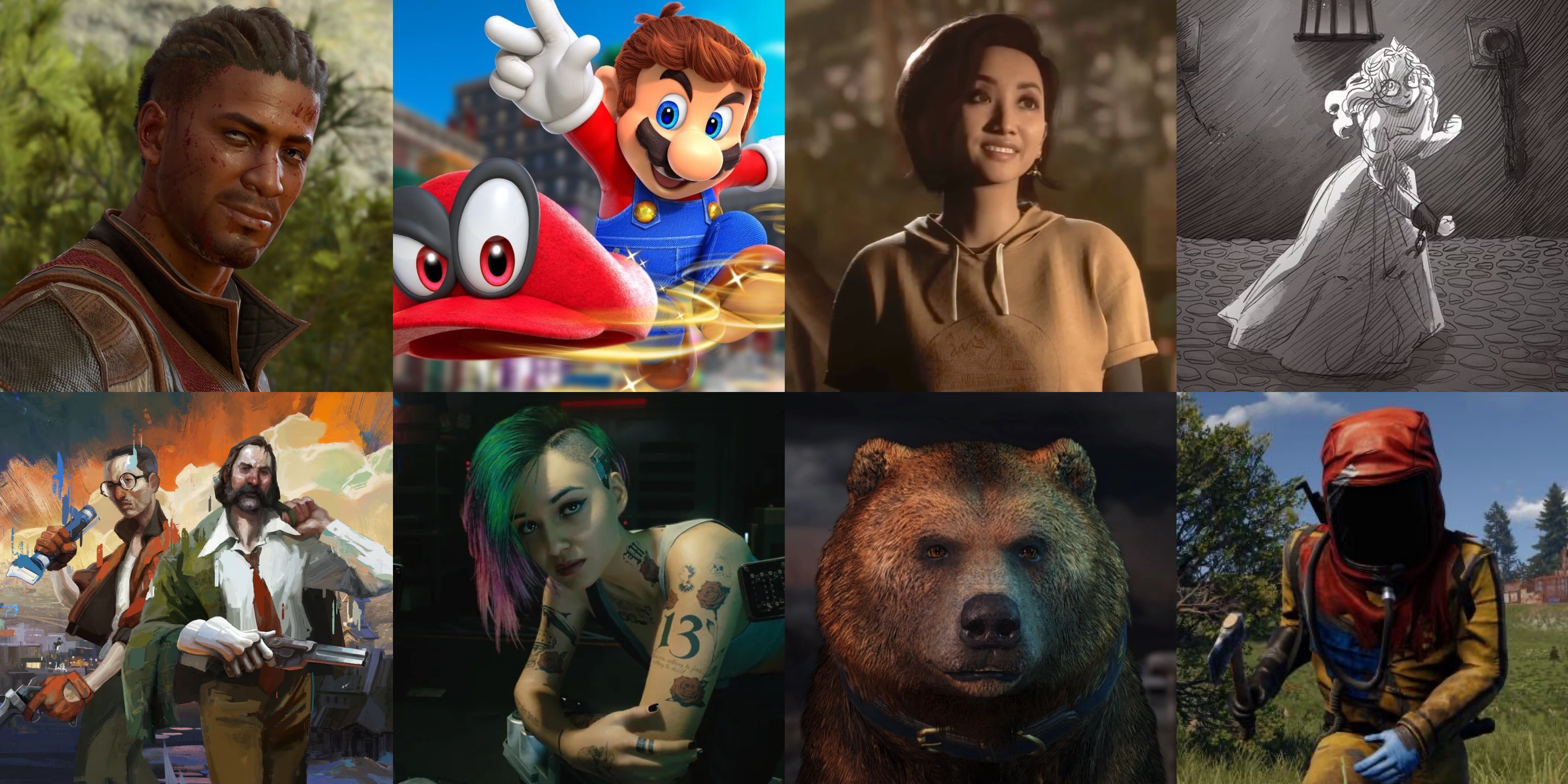
Favorite games beat in 2024: Disco Elysium, Baldur’s Gate 3, Super Mario Odyssey, and The Quarry

Games with the best music: Disco Elysium and The Outer Worlds

Games with the best character-driven stories: Disco Elysium, Baldur’s Gate 3, Star Wars Knights of the Old Republic II: The Sith Lords, and Cyberpunk 2077

Most played genres for the first time in 2024: RPG, choices-matter, and action/adventure

YouTube

Most-watched creators in 2024: Willjum, Jake Doubleyoo, ReksMore Adventures, MARCUSK, and ambiguousamphibian

Complete Lists of All Media Experienced in 2024 Are Below

LIST OF FILMS WATCHED FOR THE FIRST TIME IN 2024

The Platform (2019) dir. Galder Gaztelu-Urrutia
The First Purge (2018) dir. Gerard McMurray
Aquaman and the Lost Kingdom (2023) dir. James Wan
Ted (2012) dir. Seth MacFarlane
Ted 2 (2015) dir. Seth MacFarlane
Wonka (2023) dir. Paul King
John Wick: Chapter 2 (2017) dir. Chad Stahelski
John Wick: Chapter 3—Parabellum (2019) dir. Chad Stahelski
John Wick: Chapter 4 (2023) dir. Chad Stahelski
The Lady Vanishes (1938) dir. Alfred Hitchcock
The Bleeding Edge (2018) dir. Kirby Dick
Crazy, Not Insane (2020) dir. Alex Gibney
The Marvels (2023) dir. Nia DaCosta
Mission: Impossible (1996) dir. Brian De Palma
Mission: Impossible II (2000) dir. John Woo
In the Shadow of the Moon (2019) dir. Jim Mickle
Life (2017) dir. Daniel Espinosa
Poisoned: The Dirty Truth About Your Food (2023) dir. Stephanie Soechtig
Coded Bias (2020) dir. Shalini Kantayya
Mister Organ (2022) dir. David Farrier
Boys State (2020) dir Jesse Moss, Amanda McBaine
Miller’s Girl (2024) dir. Jade Halley Bartlett
Hellraiser (2022) dir. David Bruckner
Spaceman (2024) dir. Johan Renck
Next Goal Wins (2023) dir. Taika Waititi
Last Knights (2015) dir. Kazuaki Kiriya
Hellraiser (1987) dir. Clive Barker
Dune: Part Two (2024) dir. Denis Villeneuve
The Last Voyage of the Demeter (2023) dir. André Øvredal
Ballerina (2016) dir. Douglas Watkin
The Zone of Interest (2023) dir. Jonathan Glazer
Queenpins (2021) dir. Aron Gaudet, Gita Pullapilly
The Secret Life of the Cruise (2018) dir. Ben Ryder
Nintendo Quest: The Most Unofficial and Unauthorized Nintendo Documentary Ever! (2015) dir. Rob McCallum
Hell of a Cruise (2022) dir. by Nick Quested
Solitary: Inside Red Onion State Prison (2016) dir. Kristi Jacobson
The Anthrax Attacks: In the Shadow of 9/11 (2022) dir. Dan Krauss
The Waiting Room (2012) dir. Peter Nicks
The Last Tourist (2021) dir. Tyson Sadler
Pharma Bro (2021) dir. Brent Hodge
Persona: The Dark Truth Behind Personality Tests (2021) dir. Tim Travers Hawkins
WeWork: Or The Making and Breaking of a $47 Billion Unicorn (2021) dir. Jed Rothstein
Brandy Hellville & the Cult of Fast Fashion (2024) dir. Eva Orner
BS High (2023) dir. Travon Free, Martin Desmond Roe
15 Minutes of Shame (2021) dir. Max Joseph
American Pain (2022) dir. Darren Foster
The Truth vs. Alex Jones (2024) dir. Dan Reed
Rebel Moon – Part Two: The Scargiver (2024) dir. Zack Snyder
The Cold Blue (2018) dir. Erik Nelson
Justice League: Crisis on Infinite Earths – Part One (2024) dir. Jeff Wamester
God Forbid: The Sex Scandal That Brought Down a Dynasty (2022) dir. Billy Corben
A Compassionate Spy (2022) dir. Steve James
Enemies of the State (2020) dir. Sonia Kennebeck
After Truth: Disinformation and the Cost of Fake News (2020) dir. Andrew Rossi
Hans Zimmer: Hollywood Rebel (2022) dir. Francis Hanly
Hellboy II: The Golden Army (2008) dir. Guillermo del Toro
Triangle of Sadness (2022) dir. Ruben Östlund
The Greatest Night in Pop (2024) dir. Bao Nguyen
The Final: Attack on Wembley (2024) dir. Robert Miller, Kwabena Oppong
What Jennifer Did (2024) dir. Jenny Popplewell
Challengers (2024) dir. Luca Guadagnino
My Old School (2022) dir. Jono McLeod
Furiosa: A Mad Max Saga (2024) dir. George Miller
Butterfly in the Sky: The Story of Reading Rainbow (2022) dir. Bradford Thomason
MoviePass, MovieCrash (2024) dir. Muta’Ali
Theater Camp (2023) dir. Molly Gordon, Nick Lieberman
Civil War (2024) dir. Alex Garland
Love Lies Bleeding (2024) dir. Rose Glass
Boy Kills World (2023) dir. Moritz Mohr
Outstanding: A Comedy Revolution (2024) dir. Page Hurwitz
Hate to Love: Nickelback (2023) dir. Leigh Brooks
They Called Him Mostly Harmless (2024) dir. Patricia E. Gillespie
The Croods (2013) dir. Chris Sanders, Kirk DeMicco
Lilo & Stitch (2002) dir. Chris Sanders, Dean DeBlois
Time Bomb Y2K (2023) dir. Marley McDonald, Brian Becker
The Croods: A New Age (2020) dir. Joel Crawford
Bad Faith (2024) dir. Stephen Ujlaki, Chris Jones
IF (2024) dir. John Krasinski
The Sunset Limited (2011) dir. Tommy Lee Jones
Wish (2023) dir. Chris Buck, Fawn Veerasunthorn
The Ministry of Ungentlemanly Warfare (2024) dir. Guy Ritchie
Inside Out 2 (2024) dir. Kelsey Mann
Wild Wild Space (2024) dir. Ross Kauffman
Skywalkers: A Love Story (2024) dir. Jeff Zimbalist, Maria Bukhonina
Bones and All (2022) dir. Luca Guadagnino
Molli and Max in the Future (2023) dir. Michael Lukk Litwak
Cirque du Soleil: Without a Net (2022) dir. Dawn Porter
A Quiet Place: Day One (2024) dir. Michael Sarnoski
Sorry/Not Sorry (2023) dir. Cara Mones, Caroline Suh
Deadpool & Wolverine (2024) dir. Shawn Levy
Touch (2011) dir. Minh Duc Nguyen
Trap (2024) dir. M. Night Shyamalan
Fall (1997) dir. Eric Schaeffer
BookendS (2016) dir. Delavega
Justice League: Crisis on Infinite Earths – Part Two (2024) dir. Jeff Wamester
Justice League: Crisis on Infinite Earths – Part Three (2024) dir. Jeff Wamester
Solomon Kane (2009) dir. M.J. Bassett
Borderlands (2024) dir. Eli Roth
Suncoast (2024) dir. Laura Chinn
Coup! (2023) dir. Austin Stark, Joseph Schuman
Army of Darkness (1992) dir. Sam Raimi
Gentlemen Broncos (2009) dir. Jared Hess
Uprising (2024) dir. Kim Sang-man
Lux Æterna (2019) dir. Gaspar Noé
The Quick and the Dead (1995) dir. Sam Raimi
Kung Fu Panda 4 (2024) dir. Mike Mitchell
Sleep Call (2023) dir. Fajar Nugros
Girls State (2024) dir. Amanda McBaine, Jesse Moss
We’re All Going to the World’s Fair (2021) dir. Jane Schoenbrun
It’s What’s Inside (2024) dir. Greg Jardin
Fat Girl (2001) dir. Catherine Breillat
Overlord (2018) dir. Julius Avery
Land of Bad (2024) dir. William Eubank
Attack the Block (2011) dir. Joe Cornish
Despicable Me 4 (2024) dir. Chris Renaud, Patrick Delage
Abigail (2024) dir. Matt Bettinelli-Olpin, Tyler Gillett
Chris Brown: A History of Violence (2024) dir. Investigation Discovery
Unforgiven (1992) dir. Clint Eastwood
The Ballad of Lefty Brown (2017) dir. Jared Moshe
3:10 to Yuma (2007) dir. James Mangold
Rumours (2024) dir. Guy Maddin, Evan Johnson, Galen Johnson
Wicked (2024) dir. Jon M. Chu
Conclave (2024) dir. Edward Berger
Dream Scenario (2023) dir. Kristoffer Borgli
Buy Now! The Shopping Conspiracy (2024) dir. Nic Stacey
Joker: Folie à Deux (2024) dir. Todd Phillips
Ice Age: Continental Drift (2012) dir. Steve Martino, Michael Thurmeier
Anatomy of a Fall (2023) dir. Justine Triet
Transformers One (2024) dir. Josh Cooley
Child Star (2024) dir. Demi Lovato, Nicola Marsh
Noelle (2019) dir. Marc Lawrence
Nomadland (2020) dir. Chloé Zhao
The Wheel (2021) dir. Steve Pink
Stars at Noon (2022) dir. Claire Denis
Carry-On (2024) dir. Jaume Collet-Serra
Prey (2022) dir. Dan Trachtenberg
Lou (2022) dir. Anna Foester

LIST OF TV SHOW SEASONS WATCHED FOR THE FIRST TIME IN 2024

Peacemaker, S1
Survivor, S25, S26, S29, S36, S38, S39, S45, S47
Miracle Workers, S3, S4
Industry, S2, S3
Archer, S14
Hazbin Hotel, S1
Rick and Morty, S7
South Side, S2
Abbott Elementary, S2
Invincible, S2
Gary and His Demons, S1, S2
Bob’s Burgers, S13
Fallout, S1
Star Trek: Discovery, S5
Blood of Zeus, S2
Black Sails, S1, S2, S3, S4
Tires, S1
The Boys, S4
House of the Dragon, S2
Kite Man: Hell Yeah!, S1
The Decameron, S1
Angie Tribeca, S1
Victoria, S1
ER, S10, S11
Solar Opposites, S5
All of Us Are Dead, S1
Very Important People, S1
Boldly Going Nowhere, Unaired Pilot
The Penguin, S1
Twilight of the Gods, S1
The Legend of Vox Machina, S3
The Franchise, S1
Arcane, S2
Dune: Prophecy, S1
Secret Level, S1

LIST OF VIDEO GAMES BEAT IN 2024

Super Mario Odyssey (Nintendo Switch) – beat
Disco Elysium (Nintendo Switch) – beat: Sorry Cop; Recruit Detective Kim Kitsuragi
Rust (Xbox) – “beat” i.e. defended medium solo base against multi-player rocket raid
Star Wars Knights of the Old Republic II: The Sith Lords (Nintendo Switch) – beat
Far Cry 5 (Xbox) – beat
Fallout: New Vegas (Xbox) – beat: Yes Man independent New Vegas ending
Dragon’s Dogma: Dark Arisen (Nintendo Switch) – beat
Fallout 3 (Xbox) – beat: good karma; Fawkes hero ending
Slay the Princess (PC) – beat: “Through Conflict” and “There are no endings” ending
The Coffin of Andy and Leyley (PC) – beat: ep. 1, 2
Skyrim (Xbox) – beat: Alduin and Stormcloak questlines
The Quarry (Xbox) – beat: RIP Laura, Ryan, Jacob; (Kaitlyn survived, which was literally all I cared about)
The Dark Pictures: Man of Medan (Xbox) – beat: everybody survived
West of Loathing (Nintendo Switch) – beat
Gears 5 (Xbox) – beat
Borderlands (Xbox) – beat
Far Cry Primal (Xbox) – beat
Baldur’s Gate 3 (PC) – beat: Shadowheart left Shar; killed Raphael; freed Orpheus; Ceremorphosis; destroyed the Netherbrain; went to Avernus with Karlach to save her life; go-to team Lae’zel, Wyll, Gale
Borderlands 2 (Xbox) – beat
The Outer Worlds (Xbox) – beat: Welles ending; Adelaide McDevitt replaced Reed Tobson; sided with Halcyon Helen; established peace; saved Phineas; became leader
Cyberpunk 2077 (Xbox) – beat: left Night City with the Aldecaldos

YOUTUBE VIDEOS (VIDEOS & VIDEO ESSAYS OVER 45 MINUTES AND/OR OF NOTABLE QUALITY) WATCHED IN 2024

Rust’s most DANGEROUS Motel: The Last Stop” by ReksMore Adventures
The Complete Existential Adventures of Gerald Williams” by ambiguousamphibian
1000 Players Simulate Civilization on Survival Islands” by MARCUSK
100 Players Rebuild Civilization in a Nuclear Winter” by MARCUSK
Netflix’s Resident Evil Was a Disaster” by John Wolfe
The Second Punic War – Oversimplified (Part 1)” by Oversimplified
The Second Punic War – Oversimplified (Part 2)” by Oversimplified
The Worst King in English History?” by Drawn of History
Greek Mythology Explained (COMPILATION #1)” by Jake Doubleyoo
Norse Mythology Explained (COMPILATION #1)” by Jake Doubleyoo
Greek Mythology Explained (COMPILATION #2)” by Jake Doubleyoo
I made a NOT SO SafeZone In Rust” by ReksMore Adventures
The Absolute Chaos of Halo Infinite” by big boss
How an 18th Century Sailing Battleship Works” by Animagraffs
Games you can never play again.” by The Cursed Judge
I built a Sky base in Vanilla Rust…” by Willjum
Two Solos Build a hidden underground bunker in Official Rust…” by Willjum
I Lived on a Survival Island for 24 Hours in Rust…” by Willjum
I Built the smallest Solo Factory in Rust…” by Willjum
1000 Players, 1 Server: How a Solo PRO Survives on Official Rust” by Willjum
I hired the worlds best solo to play Rust.. (1 million sub special)” by Willjum
I Built a base under the biggest clan in Rust.. (Ft. Aloneintokyo)” by Willjum
When 2 Pros Vs an Army in Rust..” by Willjum
The Decline of Tim Burton” by Broey Deschanel
Entertainment Made By Cults” by Paper Will
The Ugly Side of Kids TV” by Paper Will
I Built the most high IQ duo base in Official Rust..” by Willjum
I rebuilt my Overpowered Fortress in 100 Hours of Rust…” by Willjum
I Built the ONLY Starter Base you’ll ever need in Rust…” by Willjum
I Lost Everything in Rust …” by Willjum
I played a solo only rust server for a week and this is what happened” by spoonkid2
I Built an Unraidable Cave base in Vanilla Rust..” by Willjum
I Unleashed a Swarm of Huntsman Spiders Into My Giant Rainforest Vivarium” by AntsCanada
I Built an Automatic Base that Defends ITSELF in Rust” by Willjum
We Built a mountain fortress in the Sky on Official Rust..” by Willjum
A Mantis Mating Disaster & Crisis in My Giant Rainforest Vivarium” by AntsCanada
I Played 100 Hours of Rust against the 3 Greatest Solos…” by Willjum
I Built the Greatest Rust Fortress against 3 Solo PROS” by Willjum
I created a village in Rust” by ReksMore Adventures
The Biggest War in Rust History” by Yexom
We Built on the LARGEST Official Server In Rust – ft Blooprint” by Willjum
We Built the GREATEST rock base in Official Rust.. Ft Blooprint” by Willjum
How the Most OP squad plays Rust – Ft. Stevie, Snuffy & Sinks” by Willjum
The BEST Rust experience in my 8000 hours..” by Willjum
Games with empty worlds.” by The Cursed Judge
Games that hate the player.” by The Cursed Judge
Pokémon sent me to Japan!” by JaidenAnimations
FOR THE EMPIRE: SEASON ONE – A Star Wars parody created with Unreal Engine 5” by AFK
FOR THE EMPIRE: SEASON TWO – A Star Wars parody created with Unreal Engine 5” by AFK
NEVER Go To The Unknown Regions – Star Wars Lore Video Compilation” by The Stupendous Wave
Max Payne… 16 Years Later” by Raycevick
Max Payne 2: The Fall of Max Payne… 14 Years Later” by Raycevick
Every Witcher KILLED by Geralt of Rivia │ Witcher Explained” by Neon Knight
Rimworld, The Complete Desert Survival Run (Condensed Series)” by ambiguousamphibian
Black Adam: How the Rock Tried to Take Over DC” by Edward Rigby
I Trapped 100 Players in the Project Zomboid Mall” by Harvest
How a 16th Century Explorer’s Sailing Ship Works” by Animagraffs
1000 Players Simulate Civilization in Rust” by FancyOrb
I Turned My Bar Into a Trap Base During the End of Civilization” by ReksMore Adventures
We don’t talk about Fight Club: Rust Edition” by ReksMore Adventures
We built a Ninja Dojo on Official Rust” by ReksMore Adventures
Why does Madame Web’s dialogue sound so weird?” by Nando v Movies
Edward Norton: the most Complicated Actor of his Generation” by Hollywood Lore
BORDERLANDS DIED TWICE” by Frogwater
I Built a solo stronghold hidden in the clouds…” by Willjum
I built an impossible solo base in vanilla rust…” by Willjum
How a Solo with 11,362 Hours plays Vanilla Rust…” by Willjum
I Played Official Rust against the 4 Greatest Solos in the world…” by Willjum
A Solo Farmer Vs 4 Rust Pros… Who will survive?” by Willjum
The Fall of the 5 Solo… Rust Movie” by Willjum
1000 Players Simulate Civilization Across Dimensions” by MARCUSK
We lived in a cube ft. Spoonkid” by ZChum Extra
I Built an unraidable Sky fortress in Vanilla Rust…” by Willjum
How The Olympics Almost Banned This Shoe” by Cleo Abram


Ben Boruff is a co-founder of Big B and Mo’ Money. Read more at BenBoruff.com.

Bones & All, Earthlings, and the Art of Anti-Othering

Trigger warning: Some of the stories discussed contain sensitive content.

Years ago, per a recommendation, I read Earthlings by Sayaka Murata. I have not been able to get it out of my mind since.

I’ve seen reviews that call Earthlings “bizarre” and “off,” but those words do little to represent the novel’s startling content. Murata’s epic story of an unconventional girl-turned-woman who believes that she may be an alien from another planet contains [trigger warnings and mild spoilers] instances of child abuse, incest, and cannibalism, among other things. Any Stephen King novel could be described as a bit “bizarre”; Murata’s book is something else entirely. A Goodreads review by a user named Robin offers an effective explanation:

If I try to explain what happens in the plot, I will sound insane. And it is. The plot is outrageous and over the top – the oppression, the abuse, and then the equally shocking response to it. It’s wild, fearless, and what makes it even stranger is that it’s told in this completely simple, straightforward, conversational tone. It draws you in, with the ease of a YA novel. You almost think, hey, this is about 11 year old kids. I’m not that interested. But don’t be fooled… it’s about to get about as dark and twisted as your worst nightmare.

And Earthlings isn’t the only Murata-written tale to accomplish this: Sayaka Murata’s slightly less extreme novel Convenience Story Woman (which I read immediately after Earthlings) shares many themes. Wired‘s Thu-Huong Ha describes the plot of the story:

[Convenience Store Woman] is told from the perspective of Keiko, a 36-year-old woman who has never had sex or held a real job and has no particular interest in either. The romance between Keiko and her place of employment is oddly moving, as is her quiet bewilderment over purpose and personhood. Keiko is happy and content, but her family worries about her. To get them off her back, she starts a sham relationship with a misogynistic coworker with whom she shares a mutual loathing. Though the reality is horrible, the setup appears conventional. Her family is thrilled.

In both stories, antagonists are everywhere, but the accusatory fingers of the narratives are pointed primarily at society—or, more specifically, at the “machine of society,” as Keiko says. Keiko (the protagonist of Convenience Store Woman) and Natsuki (the protagonist of Earthlings) are both extreme outcasts, either actively resisting societal norms or consciously mimicking them to the point of unintentional parody in attempts to avoid confrontation. And let’s be clear, Keiko and Natsuki are not outcasts in the same way as your awkward friend or your cousin who wears only black: Keiko and Natsuki are fundamentally at odds with the acceptable systems of the world. In many scenes, Keiko and Natsuki can’t even see the Overton window of societal norms—it’s too far away. Keiko and Natsuki make Holden Caulfield look like Harry Potter.

That’s the point, in part. Sayaka Murata has described wanting “to write from the perspective of someone who defied conventional thinking, particularly in a conformist society where people are expected to fulfill preordained roles.” Like a less troublesome version of Flannery O’Connor, Murata forces her readers to look deep into the eyes of individuals who categorically do not have a place in traditionally organized society (or “The Factory,” as Natsuki calls it). She holds the strange and the uncomfortable in front of our face, and she dares us to find something to appreciate.

Sayaka Nurata’s anti-society, anti-othering messages are crucial today. Luckily for us, Nurata is not the only artist who is making this commentary.

Bones and All, a romantic horror film from Luca Guadagnino (director of Suspiria and Challengers), echoes the anti-orthodox themes of Earthlings. Even on the surface, the similarities are apparent: both stories contain child abuse, cannibalism, and more. But deeper into the narrative is where the value lies. The protagonist of the film is Maren Yearly, a cannibalistic teenager who finds herself alone in the world. After Maren’s unnatural proclivities cause her father to leave, she finds herself drawn to a young man and fellow cannibal named Lee.

In Bones and All, cannibals are portrayed as a marginalized group, similar to how vampires are portrayed in popular media like Twilight and Baldur’s Gate 3: some are bad and some are good—but all are misunderstood. The cannibals’ need to feed is not quite like TV’s Dexter and his “dark passenger” that makes him kill criminals: Dexter’s desires are singular, focused, and able to be manipulated for good, unlike the cannibalistic nature of Maren and Lee. The cannibalism of Bones and All cannot be used for good: it can only be managed and understood. It is more of an identity than a temptation. In the film, all cannibals seem to be social outcasts, and most of them are aggressively cynical about society. But their cynicism is nuanced. Director Luca Guadagnino and writer David Kajganich refuse to clearly articulate the cause-and-effect relationship. Is the cynicism a result of their ostracization due to cannibalism? Or do they have other reasons for distrusting society?

And in the face of that muddy, bloody mess exists a remarkably sensitive and compelling romance—a notable M&M of positivity among the raisin-filled trail mix of death and systemic marginalization. Many viewers will find their attention drifting toward the romance and away from the horror. In other words, the film humanizes the teenage cannibals.

Robin, the Goodreads user from before, has more to say about the horrific whimsy of Earthlings‘ Natsuki, and this excerpt explains the positivity that can arise after placing wholly uncomfortable situations in front of the faces of audience members:

It’s freaky because as crazy as the main characters’ actions seem, I supported them. Why? Because living in “The Factory” – society – isn’t easy. Don’t you ever feel like an alien? I sure as hell do. Don’t you ever feel like you’d rather die than conform to what is expected of you? Or if you do, doesn’t it feel like a slow death? “The Factory” is often propagated most by those closest to us. I lived this way, so you need to, too. This is what you do now, and this is what you do next, and there’s no room for you if you don’t. There’s no room in the factory for individuality. For those healing from scars or trauma. For those who have a unique-to-them path. Murata’s characters make room. This story is told vastly outside the box. And I love it because of that.

It’s easy to be kind to outcasts when the “outcasts” you talk to are fairly ordinary. If your “outcast” sounds like Mean Girls‘ Janis, Superbad‘s Fogell, or James Dean from Rebel Without a Cause, are you really even talking to an outcast? All of those characters, while regrettably marginalized or shunned to a degree, still function effectively within the traditional structures of society. Writer Sayaka Murata and director Luca Guadagnino challenge us to look even further into the dark corners of society. Don’t just look for the person who is sitting alone in the room—look for the person who’s not even in the building. And then see if your supposedly welcoming and open-minded mentality still holds up.

Can you look into the eyes of those who reject everything about your societal norms and comforts? And can you do so without blinking?

Can you look at Keiko and Natsuki and Maren and Lee and see a human being worthy of love and acceptance?

There is a line, of course. Not all behaviors are acceptable. (It should go without saying: cannibalism is bad.) As John Oliver said, “The answer to ‘where you draw the line’ is literally always ‘somewhere.’ You draw it somewhere.” And then if you learn new information and need to redraw your line, you redraw your line.

The value of anti-othering art like Earthlings and Bones and All—the type of art that forces you to look at the strangest of society—is that it challenges us to evaluate where we have drawn our lines. Neither Murata nor Guadagnino wants you to appreciate cannibalism. But they do want you to consider why you might be shunning real-life individuals as if they were cannibals.

P.S. There’s so much more to say about these types of anti-othering stories. A (capital “R”) Romantic reading of Earthlings and Convenience Store Woman, for example, would note Murata’s use of mechanical imagery when describing the operations of society. Romantic-era thinkers celebrated individualism, natural beauty, and imagination over the “experience” of the industrialized world. Also, John Steinbeck’s Of Mice and Men could contribute to some of these ideas. Earthlings, Bones and All, and Of Mice and Men all feature aggressively marginalized characters—and all three stories qualify as tragedies. That is certainly worth dissecting.


Ben Boruff is a co-founder of Big B and Mo’ Money. Read more at BenBoruff.com.
The Supremely Important Moral of Disney’s Wish

2023’s Wish is an unfocused, poorly crafted film, but it contains one of Disney’s most important messages.

A line from Ethan Hawke’s The Hottest State summarizes a nearly universal struggle: “. . . when you’re a kid, everyone, all the world, encourages you to follow your dreams. But when you’re older, somehow they act offended if you even try.” We all know this to be true. Think back to your elementary school experience. Remember the kids who wanted to explore astronomy and self-expression and art. The kids who wanted to change the world. Remember the parents and teachers and inspirational speakers who told you to shoot for the stars. They told you that you could be anything you wanted to be. They told you to dream big. The you-can-do-anything rhetoric was everywhere. It was inescapable.

Now, try to pinpoint the moment when people stopped telling you to dream big. For many of us, it was in high school around the time we started applying for colleges and jobs. Our well-intentioned guardians and counselors began to steer us toward practicality. They didn’t condemn our dreams at first; no, they suggested small adjustments to account for their perceptions of possibility. “Put it off for just a year.” “You can do that just as a hobby for now.” “At least have a backup plan.” “Try this first.” So we began to make concessions—small at first, perhaps, but the concessions grew. In size and number. We slowly chipped away at our once big, star-focused dreams until they became bite-sized—until they became something our mentors could digest comfortably.

This is a common story. But why? Are parents and teachers lying to elementary students about their potential? Are big dreams simply fables we tell kids—like Santa Clause or the Tooth Fairy—to add a bit of fabricated excitement into their young lives? Or do guardians genuinely believe in lofty ambitions but second-guess themselves as their children grow up—so they instinctively fall back to the Alamo of digestible mediocrity?

Wish offers an answer: Big dreams are difficult and complicated. Life is simpler—and perhaps even happier at times—without them.

This is the initial motivation of Magnifico, Wish‘s villain. Magnifico’s characterization gets muddied as the film progresses—his intentions become less nuanced after the film’s first act—but his opening scenes offer a fascinating take on the reality of ambition. During his first interactions with Asha, the film’s young and admirably wide-eyed protagonist, Magnifico explains that people move to his city because they “can’t make their own dreams come true: the journey’s too hard, it is too unfair.” When Asha wonders if the citizens could try controlling their own destinies, Magnifico dismisses her supposed naivete: “Well, you’re young. You don’t know anything, really.”

Some background: King Magnifico is a sorcerer who created the kingdom of Rosas on an island in the Mediterranean Sea and promised happiness and prosperity to his citizens as long as each new citizen gave their wish (dream) to him. Citizens do not remember their abandoned wishes. Once a month, Magnifico grants the wish of a citizen. This monthly ceremony is widely celebrated until Asha learns that Magnifico has no desire to grant certain wishes.

Hidden within that plot is Magnifico’s genuine desire to help his citizens: “You’ve completely missed the point. . . . They give their wishes to me, willingly, and I make it so they forget their worries.” In the scene following that line, two new arrivals willingly give their wishes to Magnifico. “It’s a real weight off, isn’t it?” Magnifico says. And in the early stages of the film, Asha’s own grandfather echo’s Magnifico’s sentiments, growing angry when Asha tries to give him back a dream that he knows will likely not come true.

When Magnifico sings his part of “At All Costs,” then, he is not attempting to deceive Asha: he sincerely believes that he is protecting the dreams (and, by extension, the dreamers) from the harshness of reality. When he sings, “I will protect you at all costs / Keep you safe here in my arms,” he is expressing a desire to shelter his citizens from their own ambitions. Their dreams are beautiful, but their dreams are also dangerous. So, according to Magnifico, it’s better if the wishes are locked away and forgotten.

Ignore the last half of the film for a moment and consider how much this perception of Magnifico resembles the guardians, teachers, counselors, and friends who suggested that you change, alter, adapt, or delay your dreams. They wanted what is best for you, but they defined “best” in the context of predictability and practicality. Your dreams were beautiful, but they were also difficult and complicated. So they nudged you consistently toward a more simplistically blissful existence.

“It’s a real weight off, isn’t it?” they may have said when you passively took their advice.

But remember: Magnifico is the villain.

Wish argues (somewhat incoherently) that all individuals deserve the opportunity to follow their dreams—no matter how difficult, complicated, impractical, or unpredictable they may be. Wish asserts that robbing someone of that opportunity is an act of villainy. (Side note: This topic is complex: many individuals have obligations and circumstances that necessitate adaptation. And many guardians, teachers, and others are attempting to compassionately steer loved ones away from likely heartache. Caring for someone else is not easy. But when that love keeps someone from exploring their passions, it becomes problematic.)

The importance of this message cannot be overstated. We exist amid an epidemic of dreamlessness fueled by misguided pragmatism, and it will not get better until we face some hard truths. Well-intentioned or not, persuading someone to abandon or castrate their dream is regrettable. Consider this poem from Langston Hughes:

Hold fast to dreams
For if dreams die
Life is a broken-winged bird
That cannot fly.

Hold fast to dreams
For when dreams go
Life is a barren field
Frozen with snow.

Lofty ambitions are essential to life. Without them, we are not us. Without them, we have lost something that helps define who we are (i.e. a flightless bird or a barren field). Despite its thematic inconsistencies, Wish does a wonderful job of depicting this loss.

So what do we do? We push back. Following your dreams is not as simple as making a choice: it requires daily attention and energy. It’s like swimming upstream against a raging river—forever. Magnifico was right: dreams are a troublesome business. It’s much easier to forget them. So if you want to follow yours, you have to fight consciously and actively to keep them.

In Wish, the spirit of this fight is embodied by the song “Knowing What I Know Now.” As they sing, Asha and her friends prepare to challenge Magnifico and retrieve their dreams. The lyrics acknowledge the possibility of failure (“And who, who knows if we’ll succeed?”) while reinforcing the drive to try (“But we / Won’t stop and we won’t retreat or turn ’round”). In this way, “Knowing What I Know Now” operates as a Disney version of Dylan Thomas’s “Do Not Go Gentle into That Good Night“: it reminds us that dreams should not be given up easily.

Do not go gentle into that good night,
Old age should burn and rave at close of day;
Rage, rage against the dying of the light.

Though wise men at their end know dark is right,
Because their words had forked no lightning they
Do not go gentle into that good night.

Good men, the last wave by, crying how bright
Their frail deeds might have danced in a green bay,
Rage, rage against the dying of the light.

Wild men who caught and sang the sun in flight,
And learn, too late, they grieved it on its way,
Do not go gentle into that good night.

Grave men, near death, who see with blinding sight
Blind eyes could blaze like meteors and be gay,
Rage, rage against the dying of the light.

And you, my father, there on the sad height,
Curse, bless, me now with your fierce tears, I pray.
Do not go gentle into that good night.
Rage, rage against the dying of the light.


Ben Boruff is a co-founder of Big B and Mo’ Money. Read more at BenBoruff.com.

Top Movies of 2018: Mo’ Money’s Picks

Below are Mo’ Money’s top films of 2018 only including films that premiered anywhere in the world in the calendar year.

2A58BF55-8A83-4BBD-81C2-1D3FFB769940

2018 was a great year for me, but one way that it really shone was all the great movies I was able to access via streaming and physical media. My war against theaters continues, and yet I was able to see 57 movies that premiered in 2018 including a number of independent Midwestern productions. While I missed a lot of films that only played in festivals or haven’t released in the United States yet, and my list may change over the years, I believe the following movies are great and worth watching if you can access them. Continue reading

Top Movies of 2016: Jeremiah’s Picks

jeremiah-picks

Hello and welcome to Jeremiah Trotter’s top 10 movies of 2016. Now, let’s be clear: these are the top 10 movies that I enjoyed the most from 2016… that I saw. So, of course you will have different opinions and different ideas of what is “the best” of 2016, but maybe you discover something on this list that you’d like to check out. And I’m definitely not opposed to debating the merits of individual films. Anyway, let me know how you feel in the comments if you get the urge. Continue reading

Every Movie I Watched For the First Time in 2016: An Analysis

all-of-2016Earlier, I posted my ten favorite movies from 2016. But a “best of” list provides only a snapshot of a yearlong collection of movie-going experiences. If movies can impact a moviegoer’s worldview (by stimulating creativity, encouraging empathy, and raising awareness), then moviegoers should thoughtfully consider which movies they choose to watch. With this in mind, I have posted a list below of every movie I watched for the first time in 2016. Continue reading