

In the first season of Crazy Ex-Girlfriend, singer and actress Rachel Bloom (playing the clever and arguably neurotic “ex-girlfriend” Rebecca Bunch) sings “I’m In a Sexy French Depression.” In the song, Bloom lampoons the many hyper-romanticized depictions of depression that exist on screen.
Bloom’s music video looks like a scene from Michelangelo Antonioni’s La Notte (1961) or Joann Sfar’s The Lady in the Car with Glasses and a Gun (2015), and it echoes the phenomenon of mental illness FOMO that exists online. Most who have interacted with Instagram, Facebook, or TikTok are aware of the proliferation of mental health self-diagnosing, a trend that is fueled by glorified depictions of depression and Gen Z’s tendency to mordantly embrace hardships.
Identifying the line between harmfully glamorized depression (and subsequent self-diagnoses) and authentic mental health advocacy can be surprisingly tricky to identify: depression looks differently from person to person. And more importantly, a cry for attention may be fueled by a genuine need for help. (Arguably, there is no such thing as just a “cry for attention”; usually, those who are most difficult to love are those who need love the most.) Nonetheless, the distinction between romanticized mental illness and genuine mental struggles is an important one.
In “Politics and the English Language,” author George Orwell discusses the dangers of misusing language: “Most people who bother with the matter at all would admit that the English language is in a bad way. . . .” Orwell argues that we have abused language to the point that some words no longer have any practical meaning, and evidence of this is everywhere. Consider the current political landscape in America: Does the word “freedom” mean anything to you anymore? Or is it simply a buzzword that politicians of all types use in speeches and advertisements to appeal to the amorphous and fickle sensibilities of voters? If it is the latter, then we have stripped the word of practical value. If anyone can invoke freedom for any cause, regardless of logic or intent, then freedom means very little.
My contention is that we are in danger of doing the same thing to words like “depression,” “anxiety,” and “mental illness.” And this will have serious consequences: We cannot effectively help those who suffer from depression and anxiety unless we believe that depression and anxiety are real medical conditions—not simply words tossed about for sympathy and clout.
Thankfully, Orwell offers a solution: “. . . one can choose—not simply accept—the phrases that will best cover the meaning, and then switch round and decide what impression one’s words are likely to make on another person.” Put simply, we should choose our words carefully, and we should be conscious of the impact that our words have on others.
Which brings us back to Rachel Bloom. Visual depictions of mental illness can be just as damaging as the FOMO-fueled romanticized self-diagnoses that exist in text online, so we need to be careful about which depictions of depression we absorb.
Luckily, some visual depictions of depression are brilliant, nuanced, and profound. Luckily, cinematic depictions of depression exist beyond the sterilized European melancholy (AKA sad “soft swindle chic“) of sexy French depressions.
Below are ten of the most compelling depictions of depression on screen.
If you or someone you know is going through a tough time, please reach out for help. There are resources available to provide support:
- In the United States: Call or text 988 to reach the 988 Suicide & Crisis Lifeline, or use their Lifeline Chat.
- In the UK: Text “HOME” to 741741 for the Crisis Text Line.
- International Resources: The organization Befrienders Worldwide offers a database of global suicide prevention hotlines and resources.
- LGBTQ+ Resources: Visit The Trevor Project.
10. Disco Elysium (2019) pub. ZA/UM
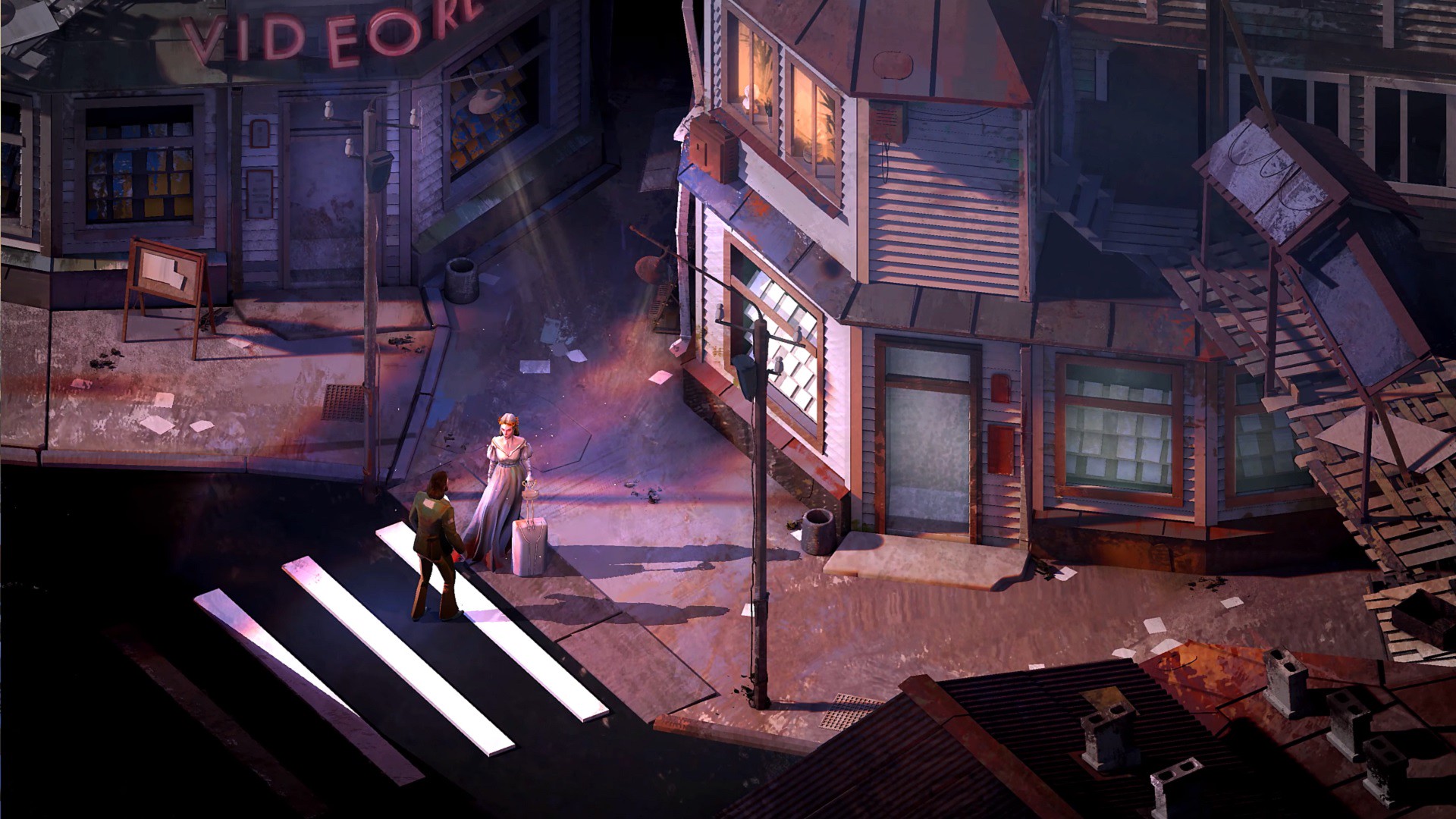
Disco Elysium is the only video game on this list, and it has more than earned its spot.
Disco Elysium is a isometric RPG that showcases the complex and chaotic story of Lieutenant Harrier “Harry” Du Bois and his attempts to solve a mysterious murder while navigating a state of drug-induced amnesia. The game’s oil-painting art style is breathtaking, and the soundtrack—both sad and exciting—provides the perfect tone for exploring the impoverished district of Martinaise within the fictional city of Revachol.
On some level, that setup is enough to justify Disco Elysium‘s place on this list. As Reddit user demonru says:
[Disco Elysium] helps me cope. I played it through twice during a month, during a terrible depressive episode and it’s deeply comforting to me. I relate to the main character on some level, the world engulfs me, the entire game is familiar and one of the kindest things I’ve encountered in my episodes. The aftertaste of the game is, to me, one of the best things about it. Listening to the soundtrack transports me to Revachol, which feels like a place I’ve lived in, and the resolution to the case and a certain subplot is just so satisfying. You put so many hours in and in the end, it’s all worth it. It’s an euphoric and engaging experience. I love it so much. I haven’t experienced it outside of a deep depressive episode yet.
But Disco Elysium goes further: the game’s mechanics explore the dark complexities of the human mind. One of the game’s key mechanics is its Thought Cabinet, which operates like a perk system for Harry’s psyche. Certain in-game decisions and conversation choices can unlock thoughts that, when “internalized,” give Harry specific buffs (or de-buffs, depending on your perspective). The Thought Cabinet is a visualized web of your character’s most notable and intimate thoughts—and the gameplay-relevant impacts of those thoughts. For example, here is the description of the Precarious World thought, which makes successes easier but offers a significant penalty while internalizing:
How not to lose? It is impossible not to. The world is balanced on the edge of a knife. It’s a game of frayed nerves. You’re pushed on by numbers and punitive measures: pain, rejection, and unpaid bills. You can either play or you can crawl under a boat and waste away — turn into salt or a flock of seagulls. Your enemies would love that. Or you can fight. The only way to load the dice is to keep on fighting.
And the Bow Collector thought, which gives you a +3 to Shivers, a skill that enhances Harry’s ability to intuit the zeitgeist and history of Revachol:
It’s early in the morning. The world is dark blue. The sparks light her face. A delicate composition of triangles. The street seems to grow longer, like in a dolly zoom. And there’s something in the air as you stand there and wave back at the shape growing smaller and smaller. Something that has always been there. A great see-through world. The tenderness you feel. The ghost of Revachol between you, carrying your signals. The holy messenger.
And this is the description of the White Mourning thought, which prompts a conversation with the Ancient Reptilian Brain, a personification of the most primal instincts lurking within the Harry’s subconscious:
…and the little guy gets smaller and smaller as you rise above the doll house world. You see him out in the snow, on the streets, in the shop on the corner, and, finally, in a matchbox house. Sitting by the window, white flowers on the window sill. You can smell them from up here: it’s awful. A white mourning. A modern death. Divorce, or something similar. All you can do is put more distance between you and him, make him smaller. Make him less you.
Another mechanic involves the skill options, which allow players to put points into one of four branches: Intellect, Psyche, Physique, and Motorics. Intellect skills, for example, include Logic, Encyclopedia, Rhetoric, Drama, Conceptualization, and Visual Calculus. And the Psyche skills are Volition (moral compass), Inland Empire (imagination), Empathy, Authority, Esprit De Corps (police mind), and Suggestion (inception/persuasion).
The mechanics, plus the gameplay itself, create a multifaceted gaming experience that explores the dark, complex subtleties of the human mind, including the possibility of depression. Disco Elysium is not the only game to depict the nuances of depression and mental health, but it is certainly one of the most compelling.
Consider how writer Logan Taylor introduces the game in his article “The Revolutionary Mind: Disco Elysium as Scale Model of Human Thought”:
There is a terror inherent to being human. We know, at all times, that some kind of pain awaits us in the future, likely not too far away. And despite this, we move forward with our lives, sometimes gleefully skating full-speed into that waiting pain. We force our way through, or at least try, and if things go well, find ourselves on the other side of it, with more in the future. It is noble to keep carrying on in the face of that. This is one of the theses of Disco Elysium.
9. Euphoria (2019-2026) created by Sam Levinson

Euphoria is a problematic show—for so many reasons. First, as YouTuber Final Girl Digital explains, viewers should be consciously wary of the “adult casting decisions” that were “often exploited and used to merely showcase the teenage characters in highly eroticized scenarios.” Second, the show romanticizes an already widespread brand of teenage nihilism that effectively nullifies any drive to better the world. Finally—and most importantly for this list—Euphoria often teeters between usefully raw depictions of mental illness and damagingly glamorized portrayals of depression. In its worst moments, Euphoria fuels the harrowing trend of mental illness FOMO and self-diagnoses that saturates the Instagram and TikTok story marketplace. Mental health awareness is beneficial, but fame-chasing self-diagnoses are certainly not.
For those reasons, I highlight Euphoria with significant hesitation; however, I do want to acknowledge the profound depictions of depression (and more) woven into Zendaya’s Rue Bennett. This is Rue’s description of a depressive episode:
One, two, three, four, five, six, seven. One, two, three, four, five, six, seven. The other thing about depression is it kind of collapses time. Suddenly, you find your whole days blending together to create one endless and suffocating loop. So you find yourself trying to remember the things that made you happy. But slowly, your brain begins to erase every memory that ever brought you joy. And eventually, all you can think about is how life has always been this way. And will only continue to be this way. I had a therapist once who said that these states will wax and wane. Which gave my mother relief because it meant that, in the bad times, there would be good times. But it also gave her anxiety because it meant that, in the good times, there would be bad times. It always confused me because I didn’t really know what it meant. But it did sound a lot calmer than the way I would describe it. Granted, I didn’t realize until later what waxing and waning implied. That these feelings were fixed and constant and would never end for the rest of my life.
This is a powerful monologue, no doubt, but Euphoria‘s most impressive contribution to depression-focused discourse is its occasionally nuanced approach to interpersonal interactions. Rue’s depression is on its most intriguing display when it is not the focus of the narrative. Because in those more subtle moments, Rue’s depression-informed actions are most relatable. In real life, depression can be surprisingly difficult to identify, and friends understandably struggle to know when (and how) to intervene. Bustle‘s Gretchen Smail explains this phenomenon as it exists in Euphoria:
Rue shows all the symptoms of going through manic and depressive states, but because bipolar disorder is so misunderstood — and its effects are sometimes subtle — her friends and family simply think she’s having a rough time. . . . Even Lexi, who’s grown up with Rue and knows her well, seems to realize Rue isn’t OK, but she isn’t sure exactly what’s going on.
And, notably, these interpersonal nuances exist against a backdrop of adolescence. Despite the show’s many (arguably foolish and troublesome) attempts to paint high schoolers as fully developed adults, Rue remains wholly immature. Rue is not the worldly sage she pretends to be; instead, she is a child who desperately wants love, acceptance, and stability. Watching the show with this in mind enhances the tragedy and meaning of Rue’s journey. Her nihilistic outlook is not simply the result of negative experience: it is the result of clinical depression—a chemical imbalance in her brain. Rue is not broken: she is sick. And she has so much time left to heal, which makes her aggressive cynicism incredibly distressing. Sofia Siqueira of The Scribe explains further:
Because she believes that she’s “too far gone,” Rue projects her dejection onto loved ones, advising them to give up on her as she has already given up on herself. Her unsparing words are no different than knives when she circles the town to verbally attack and sink every relationship she had formed since childhood. These actions are reflective of the fact that at the end of the day, Rue is just a child. Yes, she had an early and onerous introduction to substances, one that most viewers can only sympathize with. However, these experiences did not make her more mature. In actuality, they created an immense gap between what Rue is like at a normal state and a drugged one. She’s reserved and hesitant to share her emotions most of the time, and yet when she’s using, she transforms into a walking time bomb that will strike everyone with her unfiltered thoughts, many of which are heightened by her corrupted state of mind.
8. A Fantastic Woman (2017) dir. Sebastián Lelio
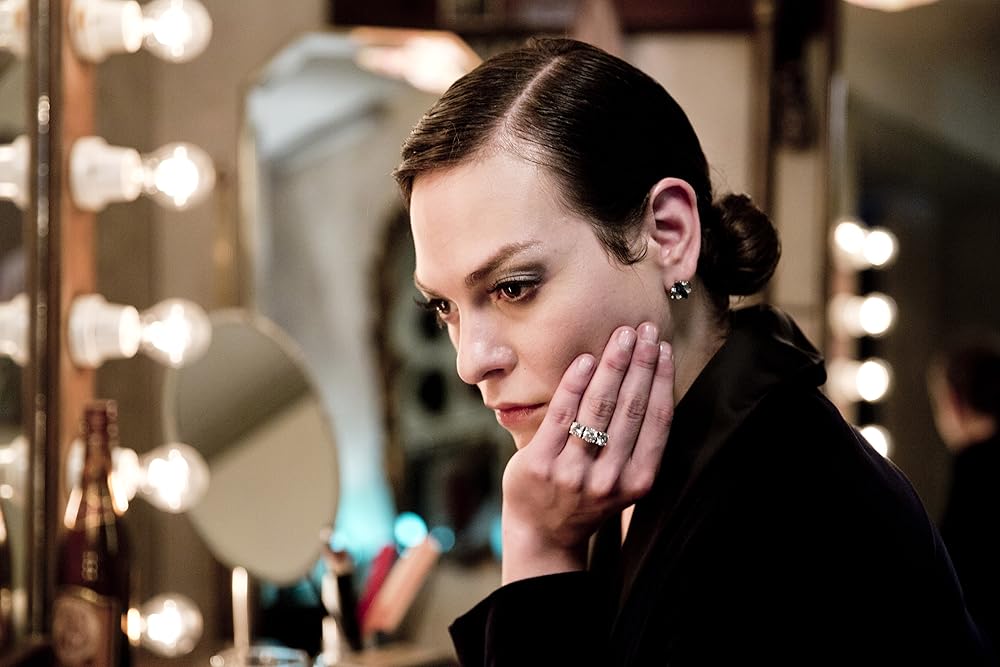
A Fantastic Woman is a Chilean film about the social and emotional struggles of a young trans woman after the death of her partner. A Fantastic Woman‘s value as a cinematic depiction of depression is less about overt nods to mental health and more about a visual and narrative exploration of deep grief, loss, and internal struggle. Consider this excerpt from Sheila O’Malley’s review of the film:
Lelio approaches this material with sensitivity and empathy. There’s restraint in his style, eloquent as it is. He weaves in elements from melodrama, from noir. Marina discovers a mysterious key in Orlando’s possessions, and her quest to discover what the key might unlock, makes up a large sequence of the film. “A Fantastic Woman” is filled with color, lights shifting from red to green to blue to yellow, bodies bathing in light, drowning in shadows. It’s an amorphous world, the borderline between night and day, consciousness and unconsciousness, is blurred. Cinematographer Benjamín Echazarreta has placed Vega at the center of every frame, her face, the back of her neck, her full body. She walks the streets of Santiago. Sometimes she is viewed from behind, sometimes she is viewed from across the street, the camera moving with her as she walks past a construction site, or along a block of storefronts. She is usually alone in the frame. Santiago often appears emptied-out of people in “A Fantastic Woman.” These choices suggest Marina’s isolation, as well as her vulnerable visibility. It’s like she’s a walking target.
For many, experiencing prolonged depression or anxiety is like walking through life with bubble-wrap over their eyes: everything is distorted. Day-to-day moments become a terraqueous mess of threats and emotional weight. And any true obstacles become exceedingly difficult to overcome.
As I read O’Malley’s review of Sebastián Lelio’s film, I was reminded of how Annie Proulx’s writes about her protagonist Quoyle in her novel The Shipping News:
Nothing was clear to lonesome Quoyle. His thoughts churned like the amorphous thing that ancient sailors, drifting into arctic half-light, called the Sea Lung; a heaving sludge of ice under fog where air blurred into water, where liquid was solid, where solids dissolved, where the sky froze and light and dark muddled.
To be depressed or anxious is to be simultaneously certain and confused. To be both aimless and destined for danger. “O, full of scorpions is my mind, dear wife!” says Shakespeare’s Macbeth. And I think both Marina and Quoyle can empathize.
A Fantastic Woman explores the psychological impacts of isolation, and it does so in a way that honors the unique struggles of its multifaceted and compelling protagonist.
7. After Life (2019-2022) created by Ricky Gervais
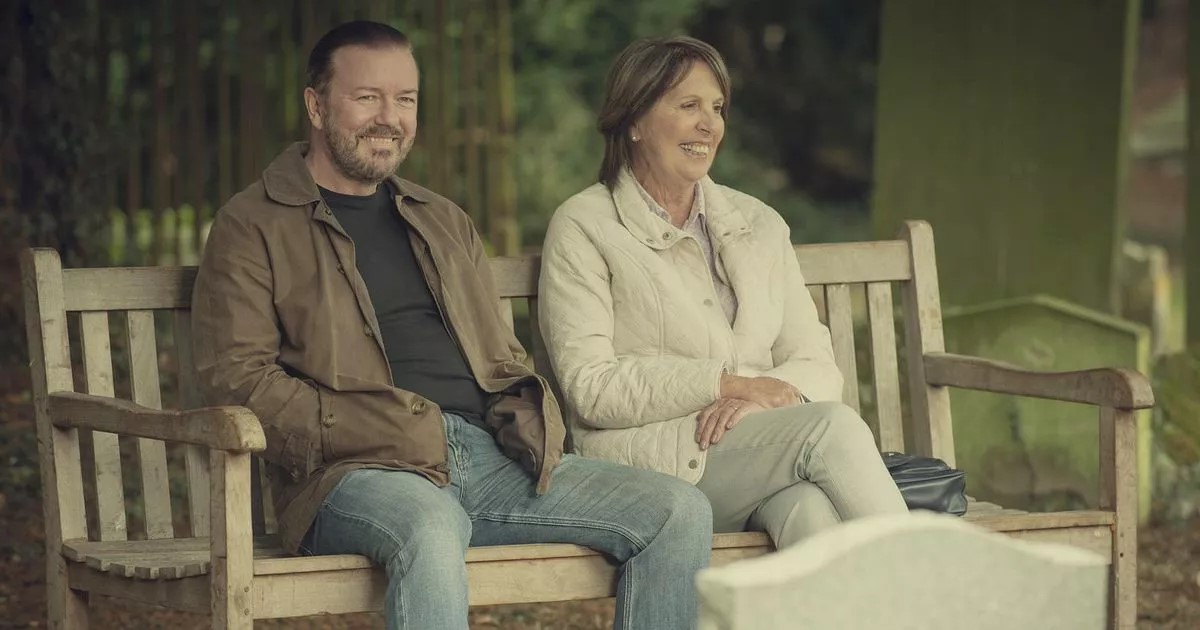
I have complicated feelings about Ricky Gervais. He’s a transphobic joke-teller who masquerades as an enlightened prophet. And many people have complicated feelings about this show. Like Euphoria, there are valid reasons to avoid After Life. Many of the show’s scenes can feel pedantic, and some characters are shamefully two-dimensional.
That said, After Life explores the self-destructive nature of some depressive experiences with a surprising amount of nuance. In the first episode, we learn that Tony (played by Gervais) has lost his wife, and this loss has sparked a particularly apathetic brand of depression. Tony says:
If I become an arsehole, and I do and say what the f*** I want for as long as I want, and then when it all gets too much, I can always k*** myself. It’s like a superpower.
Self-harm can be frustratingly difficult to discuss, so Tony’s sardonic honesty is counterintuitively refreshing.
Remember: studies consistently show that discussing self-harm does not increase the likelihood of self-harm. In fact, one study reveals that “talking about suicide may in fact reduce, rather than increase suicidal ideation, and may lead to improvements in mental health in treatment-seeking populations.”
And depression and self-harm are widespread. No one is alone. From a 2022 study:
- 22.5 million (8.8%) adults in the U.S. experienced major depression.
- 4.8 million (19.5%) kids aged 12-17 experienced major depression.
- 3.6 million (14.6%) kids aged 12-17 experienced severe depression.
- 13.2 million (5.2%) adults had suicidal thoughts.
- 3.8 million (1.5%) adults made suicide plans.
So maybe a bit of blunt honesty is a good thing. Sometimes, it’s nice to strip away all of the harmfully romanticized sophistry that permeates social media conversations about mental health. Just speak plainly. Depression is the worst. F**k suicide.
6. Thunderbolts* (2025) dir. Jake Schreier
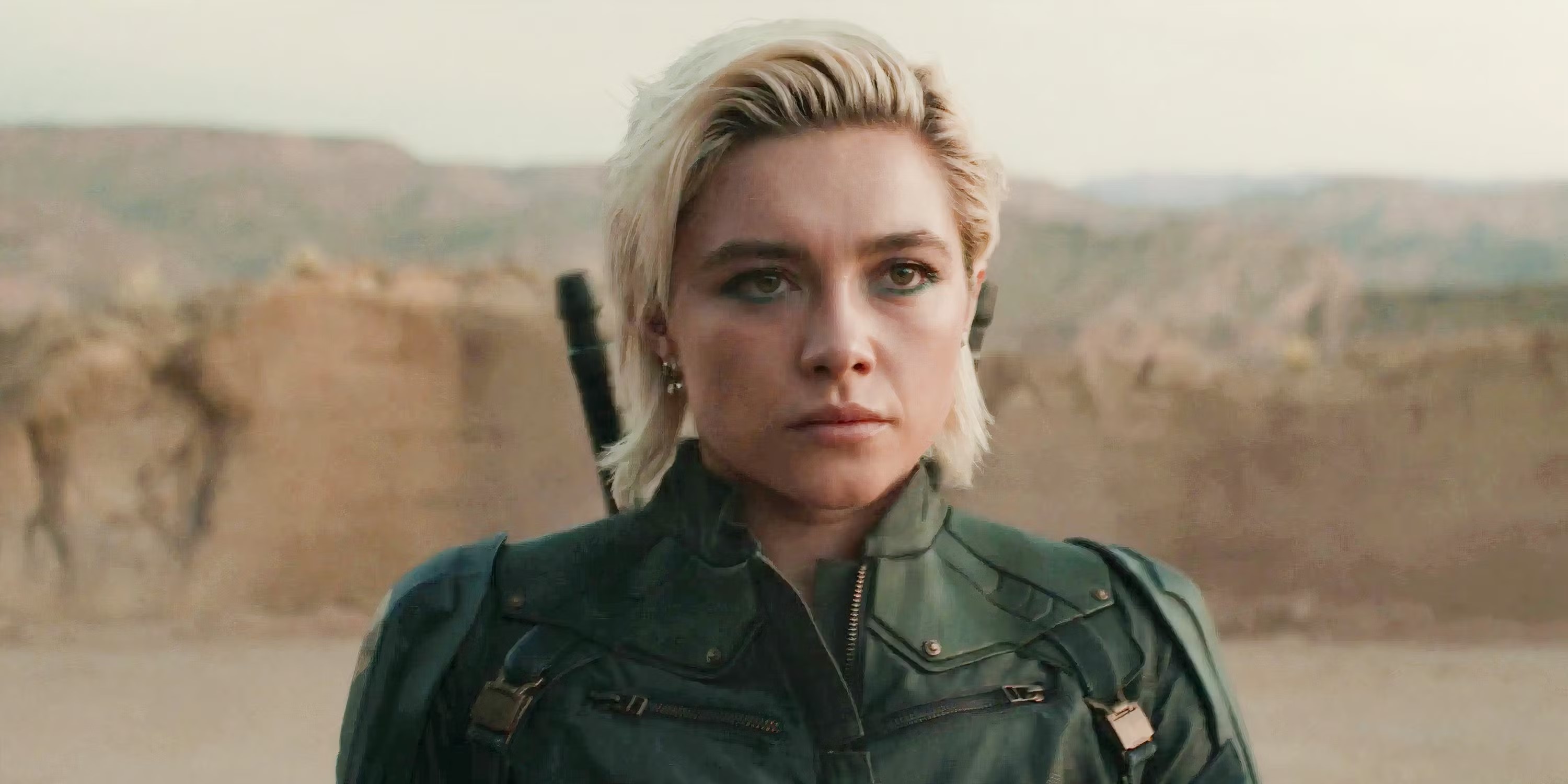
In an article published by Psychology Today, Aaron Brinen, Psy.D., calls Thunderbolts* a “masterpiece.” Brinen writes:
Movies can deliver complex messages in the form of allegory (a story that with a hidden, symbolic meaning). But I never expected Marvel’s Thunderbolts* to be a near-perfect representation of mental illness. Specifically, post-traumatic stress disorder (PTSD), associated disorders, and how cognitive behavioral therapy helps someone recover. The movie anthropomorphizes (gives human form to) the elements we address (literally, they fight) in treatment. Finally, the movie shines a light on the fact that we all have our struggles and that it is OK. . . . The Thunderbolts* is a collection of failed anti-heroes and focuses on Yelena, an ex-assassin. They are confronted with a mysterious ex-addict, Bob. He was given superpowers but holds immense darkness inside him, driven by memories of severe abuse and associated problems. When he was changed, his internal darkness destroyed everything. While this can figuratively be the case in mental illness, in this Marvel movie, it’s literal.
Some have challenged the film’s portrayal of depression—writer Tasha Robinson argues that the movie “misses one big issue with depression, the aspect of the movie that most made me shrink in my seat in the theater: the sense of shame that comes with needing this kind of help, and with putting this much weight and demand on other people”—but most critics and moviegoers concur: Thunderbolts* offers an intriguing and mostly effective allegory of mental illness.
And though I don’t think Thunderbolts* is Marvel’s most compelling depiction of depression (as you’ll see below), I agree.
5. Haider (2014) dir. Vishal Bhardwaj

Any cinematic adaptation of William Shakespeare’s Hamlet could be on this list. Perhaps Shakespeare’s most famous depressive (though there is considerable competition for that title), Hamlet struggles with his inner demons with a level of nuance and intentionality that few other literary characters have been able to replicate: “O that this too too solid flesh would melt, / Thaw, and resolve itself into a dew! / Or that the Everlasting had not fix’d / His canon ‘gainst self-slaughter! […] But break, my heart; for I must hold my tongue.”
All filmed versions of Hamlet—or at least all that are true to the story—showcase Hamlet’s depression. From David Tennant’s sharply expressive Hamlet to Ethan Hawke’s mumblecore Hamlet to Mel Gibson’s surprisingly unoffensive Hamlet to Kenneth Branagh’s perfectly multifaceted Hamlet, every actor has offered a unique flavor of the Prince of Denmark. In Haider, Shahid Kapoor’s Haider (Hamlet) showcases the belligerent energy of Hamlet’s frustrated state of mind. Many people equate depression with passivity and low energy—and those can be symptoms of depressive episodes—but depression is not always quiet or still. Research is still evolving, but some studies have linked depression with higher possibilities of violence. This does not mean that those suffering from depression are inherently violent. It also does not meant that violence is an acceptable way to cope with depression. What this does mean is that depression is a complex illness, and it manifests in different ways in different people.
Some depressives shrink. Others explode.
Vishal Bhardwaj’s Haider explores this dynamic beautifully.
4. BoJack Horseman (2014-2020) created by Raphael Bob-Waksberg
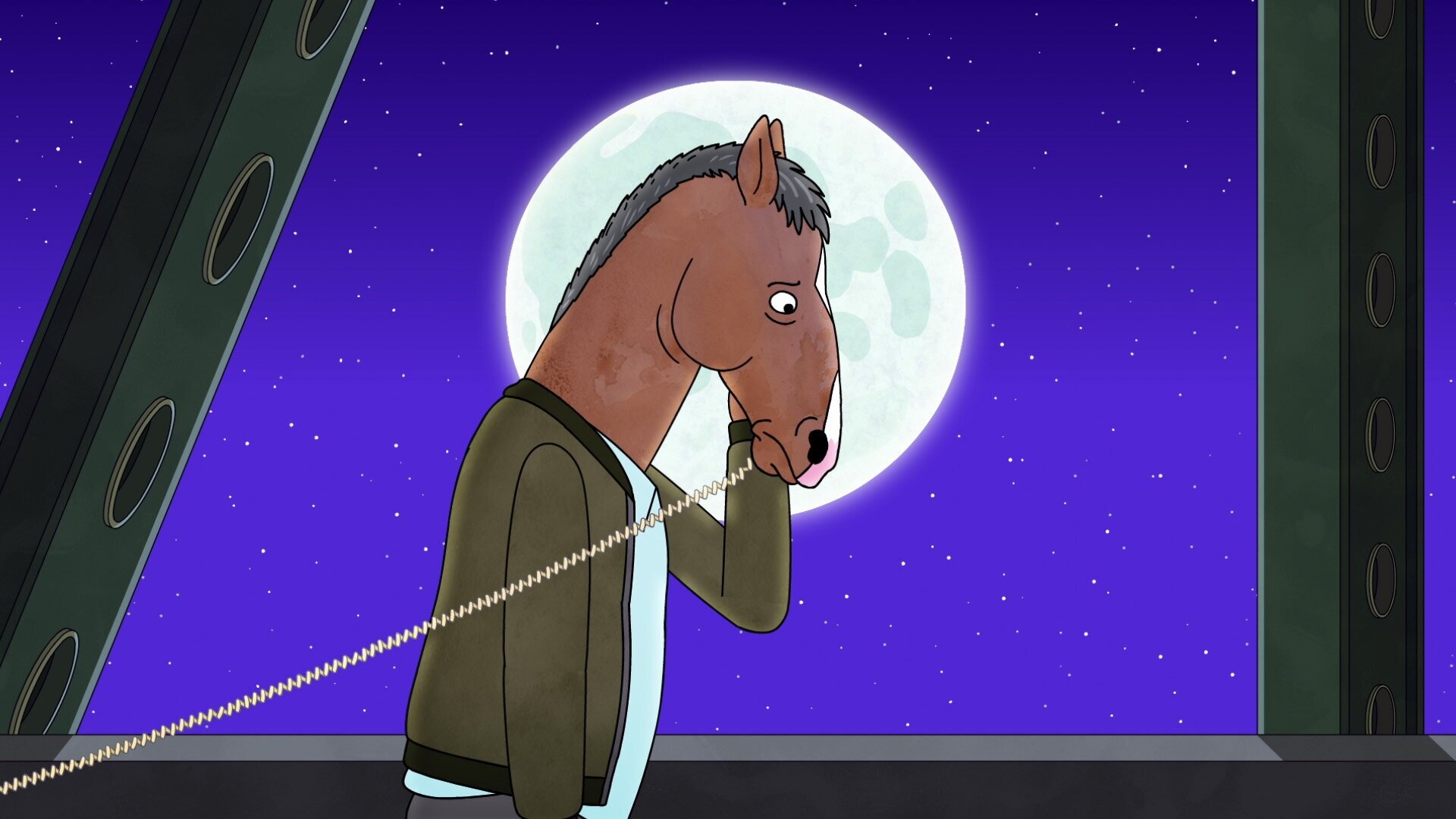
Some may be tired of articles that highlight depictions of troublesome, moody men, and that is valid. BoJack Horseman‘s Rick and Morty-esque embrace of sardonic nihilism is enough to make skeptical would-be viewers avoid Raphael Bob-Waksberg’s show about a washed-up 90s sitcom star who processes conflict by drinking, manipulating, and self-imploding. As a character, BoJack is more than troublesome: his behavior is appalling and occasionally criminal.
But there are two reasons why I include BoJack Horseman on this list: 1) the show often acknowledges and admonishes BoJack’s abhorrent behavior as part of the narrative—BoJack [spoilers] ends the series in prison “for breaking and entering and probably for everything else too”—and 2) BoJack’s depiction of depression is particularly compelling. Much more compelling than the depictions of mental illness we see from characters like Rick Sanchez.
In the season four episode “Stupid Piece of Sh*t,” we see (not for the first time) a glimpse into BoJack’s self-loathing mind:
Piece of sh*t. Stupid piece of sh*t. You’re a real stupid piece of sh*t. But I know I’m a piece of sh*t. That at least makes me better than all the pieces of sh*t that don’t know they’re pieces of sh*t. Or is it worse? . . . Yeah, it is, you stupid piece of sh*t. You’re a real stupid piece of sh*t, and everywhere you go, you destroy people. Of course your mother never loved you, what do you expect? That’s why Sarah Lynn died, that’s why Charlotte will never forgive you.
Those who have experienced depression can likely empathize, to some degree, with BoJack’s self-hating worldview. Many people have moments of heightened insecurity or low self-esteem, but for those who experience depression, their warped sense of self often operates as a seemingly permanent lens that colors all aspects of day-to-day life. It’s a stubborn, pervasive perspective that attaches itself like a parasite to all other thoughts. Moreover, it doesn’t feel like self-doubt: it feels like truth. It feels like a reality that the rest of world will see if they bother to look. Consider these lines from BoJack:
You know, sometimes I think I was born with a leak, and any goodness I started with just slowly spilled out of me and now it’s all gone. And I’ll never get it back in me. It’s too late. Life is a series of closing doors, isn’t it?
But the writers of BoJack Horseman don’t stop there: they show, with surprising nuance, how BoJack’s self-loathing nihilism negatively impacts those around him.
In one episode, BoJack’s “friend” Todd challenges BoJack’s self-pity:
You can’t keep doing this! You can’t keep doing shitty things, and then feel bad about yourself like that makes it okay! You need to be better! […] You are all the things that are wrong with you. It’s not the alcohol, or the drugs, or any of the shitty things that happened to you in your career, or when you were a kid. It’s you. All right? It’s you.
Self-loathing can be unfathomably painful, but depression is not an excuse for casual cruelty.
3. Moonlight (2016) dir. Barry Jenkins

I want to be upfront about the complexities of listing Moonlight as a film about depression: 1) no characters—including the protagonist Chiron—are explicitly labeled as depressed in the context of the film, which means that this analysis may feel like the type of unhelpful amateur diagnosis I mentioned when speaking about Euporia above, and 2) more importantly, the film focuses thematically on the intersections of masculinity, vulnerability, and Black experiences—and I do not want to undermine those conversations by reframing the narrative as a commentary on general mental health issues.
With that in mind, I want to target my analysis of Moonlight by beginning with this thesis: Barry Jenkins’ 2016 coming-of-age film Moonlight offers one of the most compelling portrayals of male emotional turmoil. For some moviegoers, the film does, in fact, offer enough evidence to diagnose Chiron with depression. After all, Chiron experiences several traumatic events as a child, and those events undoubtedly fuel his lifelong search to minimize his apparent feelings of low self-worth, hopelessness, and occasional despair, all of which are characteristic of depression. And some viewers, like The Guardian‘s Deborah Orr, go even further:
In Moonlight, Chiron, played by three actors as a child, a teenager and an adult, already has complex PTSD, to my eyes, as a little kid. Complex PTSD is brought on when a person is subjected to a series of traumas, most often by a caregiver they ought to be able to trust unconditionally, but from whom there is little chance of escape. Abused or neglected children are very susceptible to C-PTSD. By the time Chiron is an adult, from my reading of the film, C-PTSD is rampant.
But let’s take a step back and focus on the spirit of the film, which highlights the complexities of belonging and the emotional frustrations associated with feeling vulnerable. Even if depression is not in the foreground of Chiron’s story, his experiences and emotional reactions nonetheless offer lessons for those—perhaps especially men—who are experiencing depression, which often involves persistent feelings of hopelessness, aimlessness, and emotional frustration. In other words, it is possible to view Chiron’s story through the lens of mental health without overshadowing the other, perhaps deeper themes that drive the narrative.
And through that lens, the blues and purples and yellows of Moonlight‘s story reveal a harrowing bildungsroman of pervasive male loneliness and reluctance to acknowledge the inherent fragility of emotional health. Chiron exists in world where authenticity and vulnerability are chaotically intermingled with escapism and bullheadedness, and his profound struggles to navigate that world are likely familiar to men who have attempted to silently address real mental health issues. It’s like trying to swim without making a ripple—which is to say that it’s nearly impossible to do without drowning. It is no surprise that Moonlight‘s color palette is a clash of dispassionate blues and disruptive purples. And I found it particularly impactful that Juan (a drug-dealing father figure) teaches Chiron how to swim just before encouraging him to walk his own path—to avoid falling prey to the harshness of toxic masculinity.
Researchers and mental health professionals have long known that “men have inherited old social norms” like “requirements of self-reliance, limiting any emotional expression, and, most importantly, never being perceived as weak,” and these (assuredly foolish) norms complicate the process of seeking care for diagnosable mental health issues. As a case study on masculinity, Moonlight spotlights the deep, heart-rending, and psychologically painful consequences of succumbing to the myth of stoic masculinity.
For what it’s worth, researchers have found ways to combat these norms. Consider this excerpt from a study titled “Masculinity, Social Connectedness, and Mental Health: Men’s Diverse Patterns of Practice” from the American Journal of Men’s Health:
There is potential value in mental health promotion strategies which encourage and support men to openly resist, and challenge, the confines of hegemonic masculinity in relation to their social connections with others, such as demonstrating how men can change their practice in terms of social relationships, by actively crossing unwritten boundaries and reaching out to other men to purse emotionally supportive relationships, without placing a higher burden on women to achieve this. There is particular value in promoting such a message to men when they are going through significant or traumatic life events, such as cancer diagnosis or a relationship breakdown.
2. Avengers: Endgame (2019) dir. Anthony Russo and Joe Russo

Let me start with this: I understand the criticisms regarding the film’s treatment of Thor’s weight, but I think the belittling comments made by War Machine, Rocket Raccoon, and others add—likely unintentionally—an additional layer of authenticity to the portrayal of Thor’s depressive experience. In real life, depression often leads to weight gain, and many individuals in the real world are unkind when discussing the weight of others. Do I think the writers added these cheap jokes for the sake of authenticity? No. I think this is a typical case of Marvel writers overusing bathos. But do I think that Thor’s mental health journey is compelling and emotionally relatable, maybe even because of these jokes? Yes.
In fact, I argue that Thor’s journey from the beginning of The Dark World to the end of Endgame is one of the most accurate and intriguing depictions of depression in film—even more compelling than the journey of Thunderbolts‘ Yelena Belova. Intentionally or not—and at least some of it was intentional—the writers managed to portray genuine, meaningful, and lasting melancholy in the life of a literal god. Thor experienced a great amount of loss in the films preceding Endgame: he lost his mother, his father, Heimdall, Loki, his home, his hammer (and thus his self-worth), and half of his people. Like many of us, Thor desperately (and a little bullheadedly) pushed through his trauma, believing that he could out-wrestle his declining mental health. If he could only stop Thanos, then maybe the sting of his depression wouldn’t overtake him. But he couldn’t outrun his feelings, and neither can we. Thanos’s victory—coupled with the emptiness Thor felt when beheading Thanos post-Snap—finally broke him.
In Endgame, we see a man who is adrift—but still holding on. Sometimes, just getting out of bed and interacting with the world requires remarkable strength. Thor is struggling, yes, but he is not weak. Thor’s conversation with his mother is one of Marvel’s most emotionally impactful moments (on par with Yondu’s funeral in Guardians of the Galaxy Vol. 2 and the tributes to T’Challa in Black Panther: Wakanda Forever) because we see true vulnerability from one of the mightiest Avengers. “The future hasn’t been kind to you, has it?” his mother says, causing Thor to break down. And that bit of kindness and validation (from both his mother and Mjölnir) is all Thor needs to prepare himself emotionally to fight Thanos again. Thor’s journey reminds us that vulnerability is a sign of strength, not weakness.
1. Melancholia (2011) dir. Lars von Trier

I am not the first to place Melancholia at the top of a list like this. In 2021, a BBC article asked, “Is Melancholia the greatest film about depression ever made?” The article explores the film’s uniquely nuanced depiction of mental health:
[Melancholia] is so powerful because it refuses to do what people in the grip of mental illness are often pressured to do: make the pain small. There is a defiance to making the pain so big that it literally prefaces the end of the world. The combination of high-concept science-fiction and realistically nuanced characters and relationships is melded together seamlessly.
Many critics and scholars have already discussed the film’s multifaceted and artistic depictions of depression—and I strongly encourage you to watch Nerdwriter’s video essay below—so I will not spend my time parroting the insights of others. Instead, I will offer some thoughts about my personal experiences watching Melancholia in theaters. The first time I saw the movie, I was at the Keystone Art Cinema in Indianapolis. Situated in a mid-to-high-end fashion mall, the movie theater showcased an eclectic mix of foreign, blockbuster, and mildly avant-garde films, all of which were honored with a custom cocktail at the theater’s attached faux dive bar. It was a well-intentioned and very suburban art theater—the kind of place filled with khakis and polite subversion. During and after the viewing of Melancholia, the moviegoers in my theater—many of whom were over fifty years old—were silent, which I felt was appropriate given the subject matter. Depression is a serious illness, and their quietness implied a certain deference.
My second viewing of Melancholia occurred a week later at an arthouse theater near the college I attended. The oldest moviegoer was maybe thirty, and the crowd’s barely whispered conversations continued after the lights dimmed, stopping only when Kirsten Dunst finally appeared on screen. As the movie progressed, the audience reacted, at times, with laughter. When Stellan Skarsgård smashed the plate, they giggled. When Kiefer Sutherland and Charlotte Gainsbourg played with their weird homemade planet-sizing tool, they chuckled. At first, I was confused and a little indignant. Didn’t they understand the significance of what they were viewing?
But eventually, I came to a different conclusion: there is no one right way to respond to depression.
Some responses are more helpful than others, of course—and some escapist strategies can actually worsen depressive feelings—but depression is not a one-size-fits-all experience.
Which is why it is so important that we talk about depression. Honestly and intelligently. Resist the romanticized version of depression you see on TikTok. Focus instead on depictions of depression that wrestle with the truly ugly and wildly confusing facets of this complex mental illness.
Did I miss any compelling depictions of depression? Let me know in the comments.
Ben Boruff is a co-founder of Big B and Mo’ Money. Read more at BenBoruff.com.

