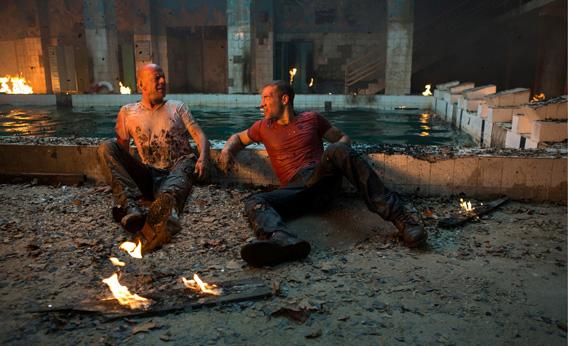
For a movie that prides itself on yippee-ki-yay-style action, A Good Day to Die Hard is well-peppered with awkward one-on-one dialogue. The new Die Hard movie has the usual explosions, gunfights, and cliched one-liners—writers replaced John McClane’s usual “I’m too old for this” catch phrases with the more original, “I’m on vacation!”—but those scenes are just toppings on a cake of weird conversations and unnecessary interactions.
The relationship between John McClane and his son, Jack McClane, is like the relationship between Bradley Cooper and Robert De Niro in Silver Linings Playbook, except without the emotional nuance and Oscar-nominated performances. Both films contain strained father-son relationships. Both pairs have communication problems. In the opening scenes of A Good Day to Die Hard, John disrupts an elaborate rescue mission by attempting to manufacture heart-to-hearts amid gunfire and car chases. McClane’s journey toward suburban-style parenting is a long one, and his son is more understanding that he should be. More understanding than I was.
While John and Jack gushed about guns and feelings, I imagined what the movie would be like if it really were a blend of Die Hard and Silver Linings Playbook.
John McClane: “Just sit down, come on. Help turn the juju around. The CIA is stupid.”
Jack: “What? Stupid? How is—you know what? Excelsior.”
John McClane: “What the f*** is ‘excelsior’?”
Jack: “You know what I’m gonna do? I’m gonna take all this negativity, and I’m going to use it to find a silver lining. I’ll be the best CIA agent ever. Better than Tony Mendez.”
I’d watch that movie. Die Hard Playbook. At least that movie would better analyze the father-son dynamic that Die Hard both highlights and under-develops. And maybe it would feature a Carter–Danny hybrid, a character played by Chris Tucker who would wisecrack his way into dangerous situations and then sweet-talk his way to freedom. And Jennifer Lawrence would be there. So many possibilities.
Let me first respond to some would-be frequently asked questions: Yes, I tend to enjoy film adaptations of young adult novels, including The Hunger Games and Warm Bodies. No, I don’t think Beautiful Creatures is the same as Twilight. Yes, I wish I had superpowers. And no, I have not yet read the book by Kami Garcia and Margaret Stohl.
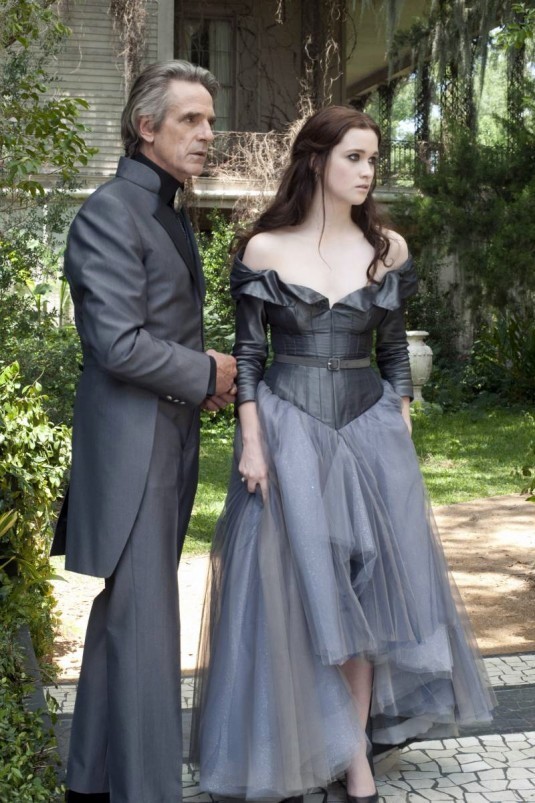
Beautiful Creaturesis the heartwarming story of a Southern boy, Ethan, who falls for a socially marginalized new-to-town classmate, Lena Duchannes. As it turns out, Lena comes from a family of “Casters,” which includes Scar from The LionKing her rich, well-spoken uncle, Macon Ravenwood, played by Jeremy Irons. Ethan and Lena eventually date, but their romance is, of course, complicated. The Southern boy and his superpowered boo must overcome small-town prejudices, Civil War curses, and an overbearing, powerful, and previously-absent mother.
But that plot, which is neither bad nor completely original, is almost secondary to the pro-intellectualism subtext that runs throughout the film. The movie opens with Ethan, a stereotypical bound-for-better-things sort of protagonist—”My momma says there’s two types of people that live in Gatlin: the people too stupid to leave and the ones too stuck to move”—who enjoys reading banned books. And Gatlin has banned a lot of books. The fictional town of Gatlin is portrayed as a conservative, hyper-religious, aggressively traditional small town that enjoys Civil War reenactments.
But Gatlin-ians are also stupid. Or ignorant. Either way, they’d rather ban books than read them, and they constantly butcher the titles of the few popular movies that happen to show at their one movie theater. Macon, Lena’s cultured uncle, once refers to the local high school as “the institution that Gatlin presumes to call educational.” And his snark seems justified.
Despite the fact that Macon’s ancestors were founders of Gatlin, Lena and her family are outcasts, social pariahs. Placing the Duchannes family on the margins of society emphasizes the difference between Castors and other mortals, of course, but it also highlights the difference between the intelligent and the reactionary, the well-read and the book banners, the cultured and the close-minded. Macon hates non-Castors, but he doesn’t dislike them because they tend to persecute his kind—he seems to dislike them because they’re unaware, uneducated, shallow.
There is only one library in Galtin, and all of the good, likable characters are somehow connected to it. Amma, Ethan’s caretaker and Macon’s confidant, works at the library, and Lethan (Lena and Ethan) visits the library frequently. Contrarily, the film’s antagonists seem repulsed by literature. The stuck-up high school bullies, Emily and Savannah, chastise Ethan for reading banned books and throw a public-prayer-filled fit when they’re asked to read To Kill a Mockingbird for English class.
The film is nuanced enough that it doesn’t further dichotomize the silly intellectualism-versus-religion discussion; instead, it offers viewers the opportunity to watch various possible reactions to ignorance. These case studies come in the form of Castors. Some Castors are good, and others are evil. But all Castors seem to lament the narrow-mindedness of other mortals. The evil ones choose to fight back, to rule the morons. The good ones choose to love the mortals, despite their flaws. In the end, the film decides to abandon the polarization altogether: “There’s a new world mama. It ain’t all dark, and it ain’t all light, and it ain’t all ours.” Maybe that’s a decent goal: Neither mock the uneducated nor tolerate ignorance. Find the middle ground.
Richard LaGravenese: Director
Richard LaGravenese: Screenplay
Alden Ehrenreich and Alice Englert: Stars
Ben Boruff is a co-founder of Big B and Mo’ Money, and he reviews indie comics for ComicBastards.com. Some of his favorite directors are Whit Stillman, Seijun Suzuki, Noah Baumbach, Kathryn Bigelow, Stanley Kubrick, Antione Fuqua, Don Hertzfeldt, Adam McKay, and Tom Hooper. Follow him on Twitter: @BenMagicAwesome.
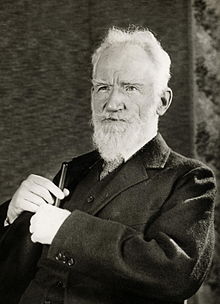
Authors have long condemned most (often all) forms of censorship. Susan Sontag wrote, “I am against censorship. In all forms.” Salman Rushdie stated that the “creative act requires not only freedom but also this assumption of freedom. If the creative artist worries if he will still be free tomorrow, then he will not be free today.” And playwright George Bernard Shaw discussed the relationship between censorship and stagnation:
“All censorships exist to prevent anyone from challenging current conceptions and existing institutions. All progress is initiated by challenging current conceptions, and executed by supplanting existing institutions. Consequently, the first condition of progress is the removal of censorship.”
But what of filmmakers? Since there have been movies, there has been censorship of film. John Waters’s 1972 Pink Flamingos was banned in several small towns in the US, and the 1932 film Scarface(presented by Howard Hughes, not Brian De Palma) was banned in a few areas in the United States for violence. And in some other countries, the battle against censorship rages more intensely. Chinese director Xie Fei said that China’s system of censorship “has only become a corrupt black spot for controlling the prosperity of the cultural and entertainment industry, killing artistic exploration and wasting administrative resources.”
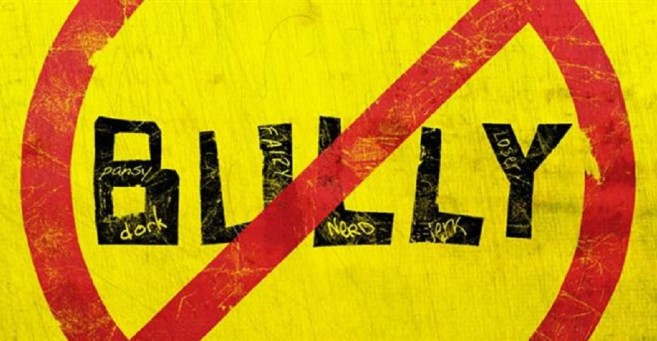
While film-banning and overbearing governments are relatively easy to notice, though, there are more covert forms of film censorship. Consider the Motion Picture Association of America (MPAA) film rating system in the United States. The MPAA’s rating scheme has its benefits, such as identifying which films are appropriate for young children, but the rating system can be a form of censorship. When paired with corporations that will only finance films that can make a profit, an NC-17, R, or even a PG-13 rating can mean the death of an original cut of a feature film (or, at the very least, significantly narrower distribution of the movie). For example, the MPAA initially gave Bully, a socially relevant documentary about the bullying crisis in schools, an R rating. Because of this, younger audiences (to whom the film was most relevant) found it difficult to see the movie. The MPAA then released it as “unrated,” which was hardly a step up (though AMC agreed to show the movie to kids with permission from parents). Finally, after great pressure from celebrities and community leaders, the MPAA lessened the rating to P-13. Still, this shows the impact that ratings can have on distribution.
Even if films weren’t banned, and even if the MPAA (and corporations) lessened their grip on distribution potential, could a film still be censored? Yes. Airplanes and FX. I watched Limitless on an international flight, and the airline deleted a mild love scene. Years later, I attempted to watch Armageddon on FX. It was hard to concentrate amid the barrage of poorly dubbed censor-edits. Since then, I’ve tried to endure similar butchering of The Departed, Rent, Pineapple Express, Mr. Deeds, and Scarface on FX and other networks. Of course, you may be thinking, “Well, Big B, just watch Showtime, STARZ, or HBO if you hate censorship so much.” But my counter-proposal is this: FX and other networks shouldn’t show those movies if they’re going to ignore artistic integrity. There are plenty of PG and PG-13 films with less questionable content—show those. If, as a network, they believe that their audience is mature enough to handle the plot of Pineapple Express, they should assume that their audience is mature enough to handle some strong language.
If I watch a movie on an airplane and entire scenes have been edited out, can I really say that I have seen the movie? If, for whatever reason, I try to watch The Departed on FX in the afternoon, can I really say that I have seen the film that Martin Scorsese created? It’s probably best that we filter what we offer to children, but we needn’t censor so aggressively.
How much should movies impact real life? To explain my answer, I have to share my thought process. Bear with me.
About six months ago, I entered the world of online dating. I was lonely and convinced myself that online dating was a step in the right direction. My logic was this: Most people my age meet their boos at bars, but bars are my social kryptonite. Something about the volume sucks the confidence out of me, killing all suaveness. Besides, my ideal meet-cute doesn’t involve vague vomit smells. Coffee shops and bookstores would be perfect for my brand of small talk, but woman aren’t expecting to be hit on while they’re sipping a vanilla latte and thumbing through the latest James Patterson. At least I don’t think so. Either way, I don’t know how to approach someone whose eyes are pinned to a book. It requires interrupting, and it’s awkward.
So I gave online dating a try. Aside from the weirdos, the creeps, and the Photoshopped fabricators, it’s a pleasant environment, like window shopping for companionship. What startled me, however, was the value I placed on my matches’ favorite movies. I found myself naturally drawn to those who listed Wes Anderson, Christopher Nolan, or John Hughes, and I quickly blocked anyone who wrote “all Nicholas Sparks movies.” But was I being too judgmental? How much do movie preferences tell us about a person? How much should movies impact real life?
I’ve bounced back and forth like a pong ball between the idea that movies mirror real life—think Brian Cox’s “Nothing happens in the world?” speech from Adaptation—and the idea that film and TV are more like Huxley’s soma or the escapism noted in Scrubs‘ sitcom episode. On one hand, society should hope that movies impact real life; otherwise, documentaries and films like FernGully: The Last Rainforest would serve no purpose. On the other hand, I’d hate to live in a town that used Michael Cera as its moral compass.
Some enjoy framing this conversation as a chicken-and-egg scenario—do movies mirror life, or does life mirror movies?—but that’s ridiculous. It’s both. The two aren’t mutually exclusive, and any nut with a brain and a remote should be able to give examples of each. The question is about the extent to which movies (should) impact our daily lives.
My perspectives are as clouded as any, clouded by my love of Aaron Sorkin and the fact that, perhaps unfairly, I am irked by social conservatives who love Glee and Rent, but I believe that the entertainment industry can do more than entertain. As Good Night, and Good Luck teaches us, televisions and movie screens can and should do more than reinforce escapism.
But if we fully embrace the messages of all films, comedies would be less funny, and horror would be more terrifying—no one would babysit alone ever again.
So there is a middle ground. But the existence of a middle ground shouldn’t be an excuse for moviegoing mediocrity. We should allow ourselves to take lessons from movies, relying on our discretion to guide us. In the same way, it does matter which movies are listed on an OkCupid profile—ideas matter. But people are multifaceted, and a love of The Blind Side doesn’t diminish your time in the Peace Corps.
When modern pop cinema replaced heart-of-gold rebel archetypes with more multifaceted characters, where did the archetypes go? When Disney seemed to shift their focus from High SchoolMusical-style filmsto more elaborate plots, where did the teen soap opera storylines go? When tween, teen, and young adult films began to offer more ethnically and economically diverse characters, where did the old racially stereotypical ensembles go?
Prom is a collection of all the outdated elements of popular teen film. Star-crossed lovers without depth. Random bursts of hormonal emotion. Smug, out-of-context attempts at wit. A disheartening lack of interracial couples. This repository of outcast archetypes boldly attempts to unravel years of social and cinematic progress.
In fact, the only somewhat uniquecharacter in Prom is Rolo, a curly-haired stoner who may or may not have a career in adult film. After spending the majority of the film casually responding to accusations that Athena, his Greek girlfriend from Canada, is not real, Rolo steals the show when he enters the prom-filled auditorium with a supermodel at his side. This spectacular entrance fascinates the other Prom characters and adds fuel to the idea that the Prom Committee may not be Rolo’s only extracurricular activity.
Movies that sport simplified moralities have some charm. Good is good, and bad is bad. There are no ethical dilemmas to process. Captain Hook has few friends; Sharptooth is Littlefoot‘s enemy; and no one cheers for the Huns in Mulan. But, sometimes, our multifaceted minds overcome our oversimplified childhoods, and we fall to the temptations of a good moral dilemma.
The modern world of superheroes and masked villains is full of such ethical quandaries. In the early 1970s, Green Lantern and Green Arrow debated various sociopolitical issues, and Spider-Man became an anti-drug icon (long before Spider-Man 3, of course). These moral questions blurred the rigid lines of right and wrong that plagued early versions of some superhero universes.
As many masked individuals have taught us, disrupting the status quo can be good or bad, depending on the situation. If crime, oppression, or apathy is the status quo, then perhaps disruption is a good idea. If the status quo is relatively pleasant and harmless, then maybe disruption is bad.
In the spirit of absurdity, I have chosen three characters that represent various approaches to existing conditions and will offer some ideas about what a possible three-way brawl might look like.
V
The only verdict is vengeance; a vendetta held as a votive, not in vain, for the value and veracity of such shall one day vindicate the vigilant and the virtuous.
Watching V for Vendettais a morally challenging experience. Or at least it should be. After the initial awe I experienced from watching a cleverly masked, cape-wearing, alliteration-abusing, knife-wielding, egg-cooking freedom fighter blow up buildings and dance around a secret hideout that could be featured on MTV Cribs, I realized that V is, in fact, a terrorist. In The Matrix, the Wachowskisiblings dulled the moral backlash against violence by allowing the would-be terrorists to run around in a fake world. V for Vendetta, however, takes place in London. A future, dystopian version of London, but still London. V did not explode fabricated buildings inside a virtual reality with the power of his mind—he blew up real buildings in London. Aside from the possible sociopolitical arguments for anti-oppression coup d’états, V for Vendetta, the film, provides a platform for unrestricted violence against authority. At best, it is violence without adequate context. At worst, it is glorified Western terrorism.
And that is what makes V such a contender in the fight against the Joker and Rorschach. V is deliberate, confident, and he can do some crazy things with knives. He’s like a masked hibachi chef who has a problem with authority (which is, by the way, a wonderful idea for a new superhero).
The Joker
You see, madness, as you know, is like gravity. All it takes is a little push!
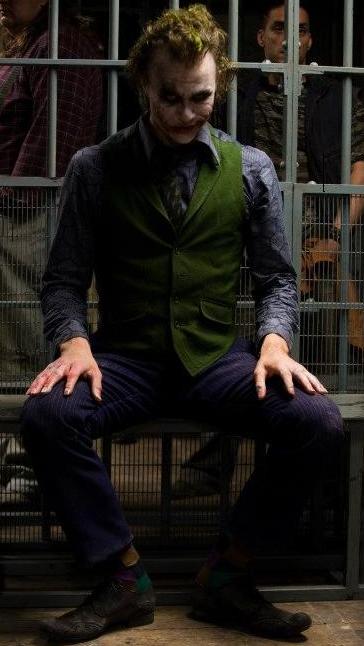
There have been many versions of the Joker. Heath Ledger played the Joker in Christopher Nolan’s The Dark Knight. And, before that, Jack Nicholson offered us an older, more bizarre Joker, a Joker that was a notch creepier than a birthday clown and a notch more acceptable than a birthday clown for a postpubescent birthday party.
There have been many animated versions of the Joker. Mark Hamill provided the Joker’s voice for a number of television shows and video games, and John DiMaggio, the guy who gives Futurama‘s Bender his voice, was the Joker in Batman: Under the Red Hood.
Think about that. The Joker has Luke Skywalker and Bender running through his voice box. If there were any character who could do justice to the juxtaposition of saber-wielding Skywalker and bolt-filled Bender, it’d be the Joker. As a villain, the Joker is a character that can make an audience laugh; question the appropriateness of laughing at dark, unprovoked violence; and then drown their moral apprehensions in cheers for more wit. As much as we love Batman, we don’t want to see the Joker die. Save Arkham Asylum for the unappealing villains like Killer Moth and Catman.
The Joker’s unpredictability is his greatest advantage. The Joker wouldn’t follow any of Brad Pitt‘s rules if he joined Fight Club. He’d wear a shirt and shoes AND tell all of friends about the group. And, if it were his first time at Fight Club, he wouldn’t fight. He’d just stand in the corner until the rest of the group forgot about him. Then he’d start multiple fights with multiple people. And then he’d leave because the Joker doesn’t join clubs.
Rorschach
Never compromise. Not even in the face of Armageddon.
Rorschach has the punch of wasabi and the cleansing power of sorbet. Rorschach is the Chuck Norris of grim superheroes. His Bauer-like no-nonsense attitude complements his Anton Chigurh brutality. He has the voice of Batman, the wit of Mr. Blonde, and the wardrobe of Dick Tracy. He employs a Corleone-style morality and a Dignam-ish sense of duty. He is, in a word, badass.
Rorschach fights criminal aggression with patient brutality. To say he fights fire with fire is to misrepresent Rorschach’s intensity. Rorschach fights fire with hotter, bigger, more awesome fire. His ironclad integrity allows him to take his struggles against criminality personally without losing motivation or willpower. And we love him for it. In Watchmen, Dr. Manhattan’s blue manhood may be enjoying a lot of fresh air, but it is Rorschach who steals the show.
Morally, Rorschach is problematic. Because he subscribes to an end-justifies-means philosophy, Rorschach’s actions often score high on immorality scales, but we don’t question his status as a good guy. His response to villains is villainy, but Rorschach himself is still a hero. This paradox is unraveled somewhat by Rorschach’s self-sacrificial actions at the end of Watchmen. Rorschach must step aside for peace to survive.
This is why I believe that, if they were ever to fight, Rorschach would beat V and the Joker. Rorschach’s intensity and personal conviction ultimately trump V’s intentionality and the Joker’s unpredictability. Before you disagree, watch this trailer one more time:
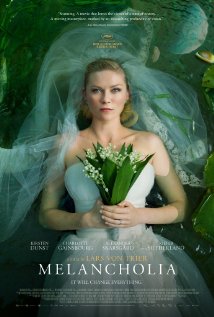
I saw Melancholiatwice in theaters. The first time I saw the movie was at an artsy theater in Indianapolis. The audience was quiet, focused, and alert, absorbing all of the subtle and profound emotions portrayed by Kirsten Dunst and Charlotte Gainsbourg.
The second time was at a theater in a college town. The audience was loud, talkative, and arrogant. And they were definitely more intoxicated than the Indianapolis audience, which is weird because the artsy theater offered alcohol (and the university had a supposedly dry campus). Though, to be fair, I don’t blame the college students. If I was sporting a 1.5 GPA because of a moderate Call of Duty addiction and was going to see a movie about the slow demise of our planet, I’d probably drink too.
What intrigued me, however, was how the different audiences impacted my perception of the movie.
via IMDb.com
Before diving into that ocean of gaudy introspective self-praise, though, I need to explain a little about Melancholia.Lars von Trier‘s 2011 film is a beautiful juxtaposition of the emotional and mental struggles of two sisters and a newly discovered planet that likes to invade Earth’s personal space. Kirsten Dunst plays Justine, a personification of depression and doom. For the first half of the film, the audience watches Justine destroy her wedding bit by excruciating bit. The second half of the film follows Claire, Justine’s sister, as she tries to juggle Justine’s emotional state, a creepily quiet child, Jack Bauer, and a new planet that may end all life.
So when the booze-filled audience burped their laughs, I was surprised. Depression and interplanetary tango is not exactly comedic gold. But, in some ways, it worked. Melancholia offers a dark look at life on the edge (in more than one way), and sometimes mild laughter is a good way to deal with impending doom. Also, if good movies aren’t your preference and you get bored while watching this wonderful film, it’s sort of fun to imagine Spider-Man swooping in to save Kirsten. Or Kiefer Sutherland yelling at someone.
“Life is only on Earth. And not for long,” says Justine with tired eyes.
“Like Hell it is!” growls Jack Bauer, cocking his gun and running toward the sunset.
Lars von Trier: Director
Lars von Trier: Writer
Kirsten Dunst, Charlotte Gainsbourg, and Kiefer Sutherland: Stars
If you’re looking for a movie about well-dressed, foul-mouthed gangsters who tell tasteless jokes and spend great amounts of time debating the finer sociological aspect of tipping at restaurants, Quentin Tarantino’s Reservoir Dogs is the movie for you. It is a simple, mobster-style movie peppered with flashbacks and gunfire. Though the plot is coated with mystery, the film plays more like a character-drama, chronicling some important moments in the lives of a few complicated individuals.
Oh, and congratulations, Steve Buscemi.
WARNING: OFFAL SPOILER ALERT
Congratulations, Steve Buscemi. Reservoir Dogs highlights the crazy antics of one of Buscemi’s most successful characters. In this case, “successful” refers not to the critics’ responses to Buscemi’s character but to the character’s relative success in the actual events that occur during the course of the movie. This relative success is celebration-worthy because Buscemi’s characters don’t often succeed. A Buscemi-played character is likely to become mentally unstable, mangled, or dead. Let’s look at some of Steve Buscemi’s characters:
Carl Showalter, Fargo (1996). A hot-tempered crook whose deranged mind has trouble processing changes to well-made plans. Deceased.
Rockhound, Armageddon (1998). A bizarre genius who shows no respect for the seriousness of working on an asteroid. Mentally unstable.
Donny Kerabatsos, The Big Lebowski (1998). A curious pushover who suffers through verbal abuse and unprovoked hostility without complaint. Deceased.
James McCord, The Island (2005). A helpful techie whose philanthropic spirit doesn’t get to see the second half of the movie. Deceased.
Wiley, Grown Ups (2010). An overgrown child whose friends have little respect for his physical well-being. Mangled.
And that is just a sample. Sure, there are exceptions to this trend, but the already small list of anomalies is saturated with relatively unlikable characters like Randall Boggs from Monsters, Inc., Garland Greene from Con Air, and Clint Fitzer from I Now Pronounce You Chuck & Larry.
Of course, given the release dates of these movies, it is possible that Buscemi perfected his oddball character type after playing Mr. Pink in Reservoir Dogs. But, still, it’s comforting to know that at least a couple of Steve Buscemi’s characters had relative success in their respective universes. And it is relative success: Mr. Pink probably died.
But, of course, all of this is a testament to Buscemi’s artistic skill. His ability to consistently provide moviegoers with compelling and often comedic weirdos/sociopaths is unparalleled. Thank you, Steve Buscemi, and congratulations.
Flashbacks of a Fool is a coming-of-age tale about forbidden romance, teenage innocence, and the dangers of old sea mines. More importantly, it is evidence that brilliance can exist without coherence or flow.
The movie is about a struggling Hollywood star and his bizarre past. The star, played by Daniel Craig, is a promiscuous, emotionally immature has-been who discovers that a childhood friend has passed away. Instead of casually reminiscing about his childhood while relaxing on his couch or listening to Enya’s “Orinoco Flow” over and over (which is a great way to relax, by the way), Joe Scot (Craig) decides to go for a semi-drunk swim. This, of course, brings about a rather long flashback, a flashback that lasts for nearly half of the movie and includes impromptu dancing, intergenerational intercourse, and unexploded mines.
Baillie Walsh, the writer/director, guides the audience through a beautiful cacophony of settings, camera angles, and storylines without regard for context or flow. This is Walsh’s first and only feature film, but that fact didn’t seem to stop the novice director from peppering the occasionally cliché film with some beautifully absurd scenes. The film is a constant war between art and kitsch, and Walsh doesn’t seem to care which side wins. Using the flashback gimmick as a weak invisibility cloak for randomness, Walsh embraces the kitsch of his protagonist’s childhood, and that willingness to flaunt cinematic spontaneity allows Walsh to blur the lines between gaudiness and beauty. The movie’s flashback scenes, as a whole, are like the contents of a particularly unique party mix—both delicious and unnerving—and their weirdness helps explain the protagonist’s reluctance to relive his past.
Flashbacks of a Fool encourages paradoxical descriptors. It is both fascinating and dull, gaudy and beautiful, kitschy and artsy, ignorant and self-aware, easy and confusing, complicated and simple. The video below (featuring the lovely Felicity Jones) is beauty without context. When the scene first appears in the film, it seems random and spontaneous, yet it is crucial to the film’s ending. Enjoy its beauty. Embrace its absurdity.
Baillie Walsh: Director
Baille Walsh: Writer
Daniel Craig, Harry Eden, and Felicity Jones: Stars
Though I eventually decided that “Welcome Back: A Tribute to Will Smith” most effectively described the intent of this blog post, any number of titles would have appropriately reflected my feelings. Other titles I considered:
Will Smith: The Man of My Heart
Huzzah! – The Story of Will Smith and Big B
Why I Haven’t Loved Since 2008
Men in Black III will be Off the Chain
I Am Going to Have Three Kids and Name Them Bagger Vance, Fresh Prince, and Agent J
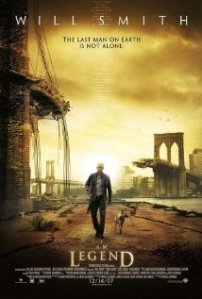
Will Smith, star of movies like Independence Day (1996) and The Legend of Bagger Vance (2000), has been absent from the screen since 2008, the year he made Seven Pounds. Given the dismal quality of Seven Pounds, true Will Smith fans were not surprised when Smith took some time away from acting. After all, artists need time to reflect on their work. But, as the years rolled on, Smithians (fans of Will Smith) began to wonder if their idol would ever return. Some coped with Smith’s absence by hosting The Fresh Prince of Bel-Air marathons while others reenacted the plot of Hitch with strangers. But, for all, the lack of Will Smith movies made those few years nearly unbearable.
via IMDB.com
But, finally, Smithians can put down their copies of Bad Boys II and breathe a sigh of relief. Will is back. No longer do they have to listen to hours of “Whip My Hair,” praying that Willow’s voice will somehow connect them to Mr. Smith. Men in Black III, starring Will Smith, should be in theaters in May of 2012.
Some faux-Smithians wonder if Smith will be rusty after such a long sabbatical. But, true Smithians simply reply, “He is legend,” and allow the anticipation for another Will Smith blockbuster to overshadow less important thoughts. To prepare for Smith’s return, some Smithians may rehearse the theme song of The Fresh Prince of Bel-Air. Some may grow a mustache in honor of The Pursuit of Happyness (2006). Some may burn copies of Seven Pounds. And some may write fan fiction for Shark Tale (2004).
Me? I’m going to listen to this song. Again and again.

 For a movie that prides itself on yippee-ki-yay-style action, A Good Day to Die Hard is well-peppered with awkward one-on-one dialogue. The new Die Hard movie has the usual explosions, gunfights, and cliched one-liners—writers replaced John McClane’s usual “I’m too old for this” catch phrases with the more original, “I’m on vacation!”—but those scenes are just toppings on a cake of weird conversations and unnecessary interactions.
 While John and Jack gushed about guns and feelings, I imagined what the movie would be like if it really were a blend of Die Hard and Silver Linings Playbook.
 I’d watch that movie. Die Hard Playbook. At least that movie would better analyze the father-son dynamic that Die Hard both highlights and under-develops. And maybe it would feature a Carter–Danny hybrid, a character played by Chris Tucker who would wisecrack his way into dangerous situations and then sweet-talk his way to freedom. And Jennifer Lawrence would be there. So many possibilities.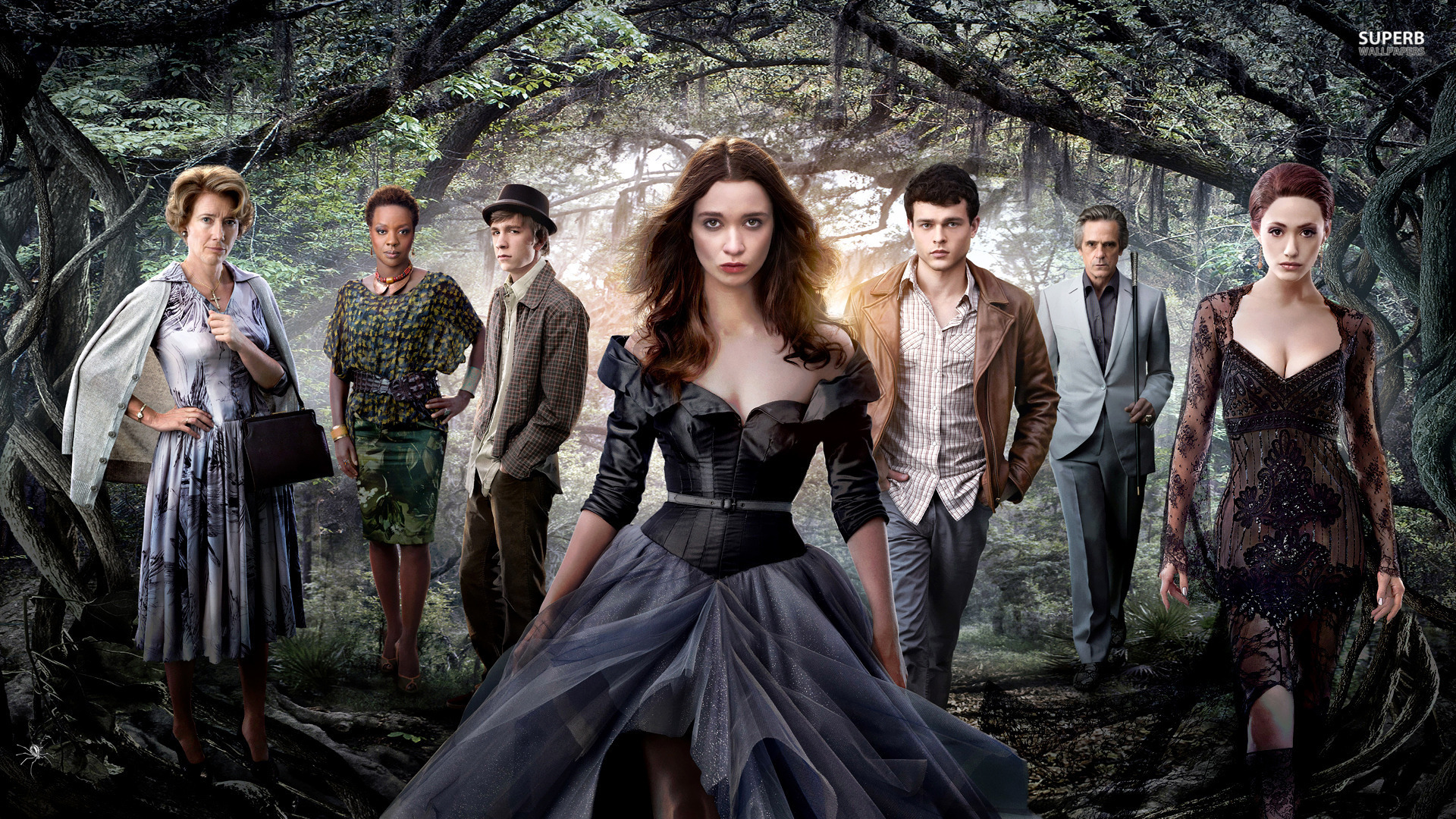








 Big B and Mo' Money