Review: A Good Day to Die Hard (2013): “You know what? Excelsior.”

Good Day to Die HardFor a movie that prides itself on yippee-ki-yay-style action, A Good Day to Die Hard is well-peppered with awkward one-on-one dialogue. The new Die Hard movie has the usual explosions, gunfights, and cliched one-liners—writers replaced John McClane’s usual “I’m too old for this” catch phrases with the more original, “I’m on vacation!”—but those scenes are just toppings on a cake of weird conversations and unnecessary interactions.

The relationship between John McClane and his son, Jack McClane, is like the relationship between Bradley Cooper and Robert De Niro in Silver Linings Playbook, except without the emotional nuance and Oscar-nominated performances. Both films contain strained father-son relationships. Both pairs have communication problems. In the opening scenes of A Good Day to Die Hard, John disrupts an elaborate rescue mission by attempting to manufacture heart-to-hearts amid gunfire and car chases. McClane’s journey toward suburban-style parenting is a long one, and his son is more understanding that he should be. More understanding than I was.

A-Good-Day-to-Die-Hard BrosWhile John and Jack gushed about guns and feelings, I imagined what the movie would be like if it really were a blend of Die Hard and Silver Linings Playbook.

John McClane: “Just sit down, come on. Help turn the juju around. The CIA is stupid.”

Jack: “What? Stupid? How is—you know what? Excelsior.”

John McClane: “What the f*** is ‘excelsior’?”

Jack: “You know what I’m gonna do? I’m gonna take all this negativity, and I’m going to use it to find a silver lining. I’ll be the best CIA agent ever. Better than Tony Mendez.”
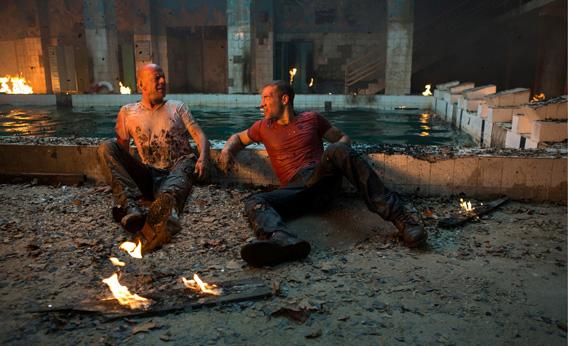
Good Day to Die Hard PalsI’d watch that movie. Die Hard Playbook. At least that movie would better analyze the father-son dynamic that Die Hard both highlights and under-develops. And maybe it would feature a CarterDanny hybrid, a character played by Chris Tucker who would wisecrack his way into dangerous situations and then sweet-talk his way to freedom. And Jennifer Lawrence would be there. So many possibilities.

John Moore: Director

Skip Woods and Roderick Thorp: Writing

Bruce Willis and Jai Courtney: Stars
Review: Beautiful Creatures (2013): “For goodness’ sake, read a book!”

Beautiful Creatures 2SPOILERS

Let me first respond to some would-be frequently asked questions: Yes, I tend to enjoy film adaptations of young adult novels, including The Hunger Games and Warm Bodies. No, I don’t think Beautiful Creatures is the same as Twilight. Yes, I wish I had superpowers. And no, I have not yet read the book by Kami Garcia and Margaret Stohl.

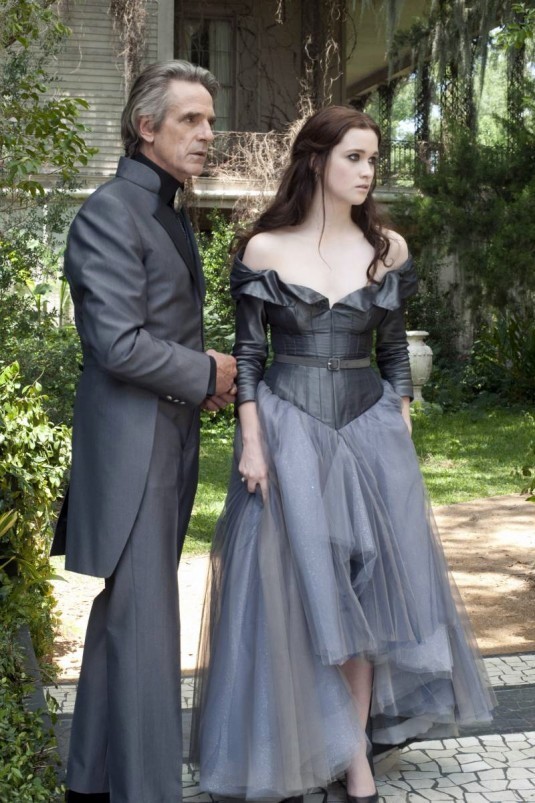
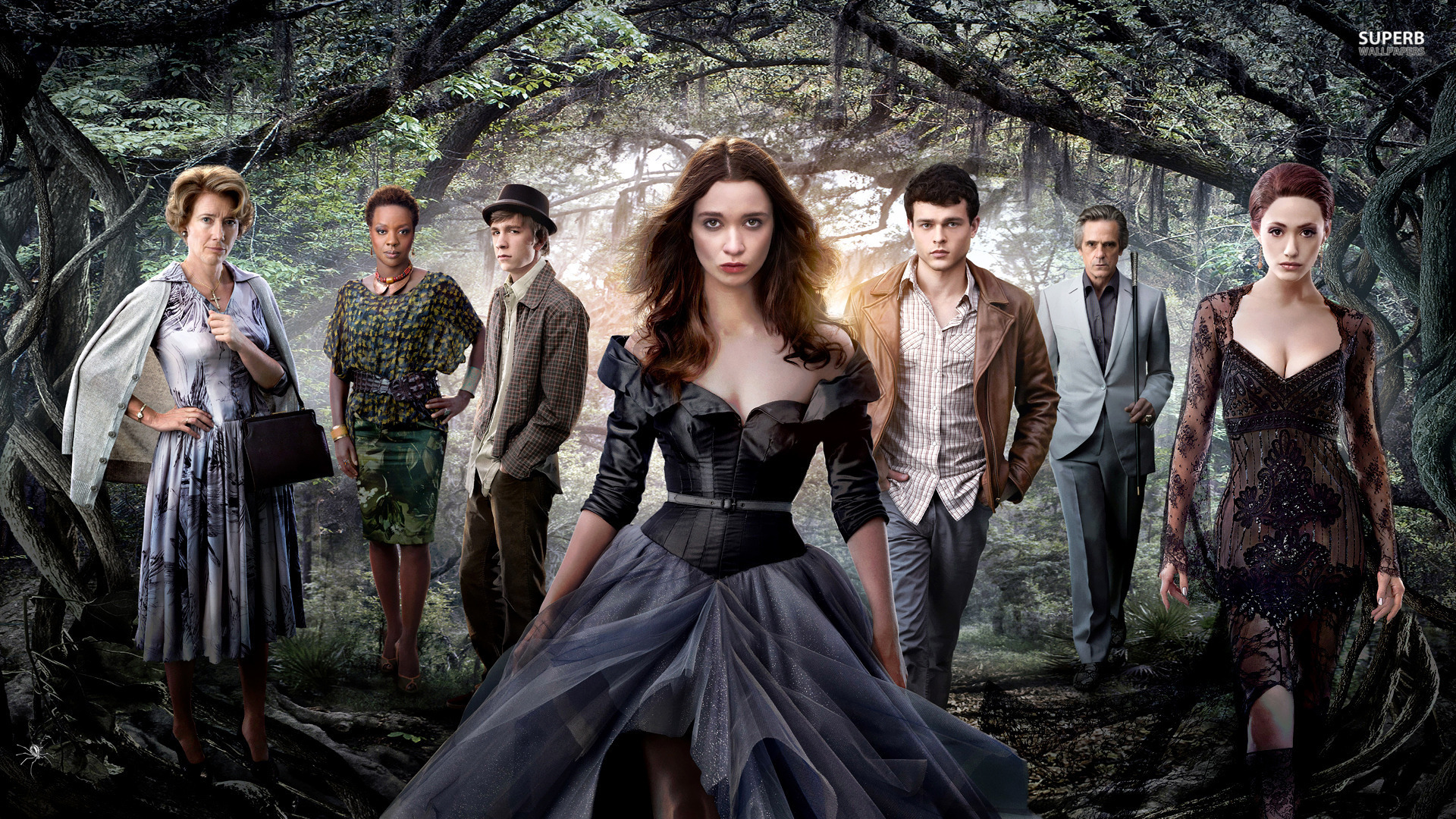
Beautiful Creatures is the heartwarming story of a Southern boy, Ethan, who falls for a socially marginalized new-to-town classmate, Lena Duchannes. As it turns out, Lena comes from a family of “Casters,” which includes Scar from The Lion King her rich, well-spoken uncle, Macon Ravenwood, played by Jeremy Irons. Ethan and Lena eventually date, but their romance is, of course, complicated. The Southern boy and his superpowered boo must overcome small-town prejudices, Civil War curses, and an overbearing, powerful, and previously-absent mother.

Beautiful Creatures MaconBut that plot, which is neither bad nor completely original, is almost secondary to the pro-intellectualism subtext that runs throughout the film. The movie opens with Ethan, a stereotypical bound-for-better-things sort of protagonist—”My momma says there’s two types of people that live in Gatlin: the people too stupid to leave and the ones too stuck to move”—who enjoys reading banned books. And Gatlin has banned a lot of books. The fictional town of Gatlin is portrayed as a conservative, hyper-religious, aggressively traditional small town that enjoys Civil War reenactments.

But Gatlin-ians are also stupid. Or ignorant. Either way, they’d rather ban books than read them, and they constantly butcher the titles of the few popular movies that happen to show at their one movie theater. Macon, Lena’s cultured uncle, once refers to the local high school as “the institution that Gatlin presumes to call educational.” And his snark seems justified.

Despite the fact that Macon’s ancestors were founders of Gatlin, Lena and her family are outcasts, social pariahs. Placing the Duchannes family on the margins of society emphasizes the difference between Castors and other mortals, of course, but it also highlights the difference between the intelligent and the reactionary, the well-read and the book banners, the cultured and the close-minded. Macon hates non-Castors, but he doesn’t dislike them because they tend to persecute his kind—he seems to dislike them because they’re unaware, uneducated, shallow.

Beautiful CreaturesThere is only one library in Galtin, and all of the good, likable characters are somehow connected to it. Amma, Ethan’s caretaker and Macon’s confidant, works at the library, and Lethan (Lena and Ethan) visits the library frequently. Contrarily, the film’s antagonists seem repulsed by literature. The stuck-up high school bullies, Emily and Savannah, chastise Ethan for reading banned books and throw a public-prayer-filled fit when they’re asked to read To Kill a Mockingbird for English class.

The film is nuanced enough that it doesn’t further dichotomize the silly intellectualism-versus-religion discussion; instead, it offers viewers the opportunity to watch various possible reactions to ignorance. These case studies come in the form of Castors. Some Castors are good, and others are evil. But all Castors seem to lament the narrow-mindedness of other mortals. The evil ones choose to fight back, to rule the morons. The good ones choose to love the mortals, despite their flaws. In the end, the film decides to abandon the polarization altogether: “There’s a new world mama. It ain’t all dark, and it ain’t all light, and it ain’t all ours.” Maybe that’s a decent goal: Neither mock the uneducated nor tolerate ignorance. Find the middle ground.

Richard LaGravenese: Director

Richard LaGravenese: Screenplay

Alden Ehrenreich and Alice Englert: Stars


Ben Boruff is a co-founder of Big B and Mo’ Money, and he reviews indie comics for ComicBastards.com. Some of his favorite directors are Whit Stillman, Seijun Suzuki, Noah Baumbach, Kathryn Bigelow, Stanley Kubrick, Antione Fuqua, Don Hertzfeldt, Adam McKay, and Tom Hooper.  Follow him on Twitter: @BenMagicAwesome.

Review: Prom (2011)

When modern pop cinema replaced heart-of-gold rebel archetypes with more multifaceted characters, where did the archetypes go? When Disney seemed to shift their focus from High School Musical-style films to more elaborate plots, where did the teen soap opera storylines go? When tween, teen, and young adult films began to offer more ethnically and economically diverse characters, where did the old racially stereotypical ensembles go?

They went to Prom.

Prom is a collection of all the outdated elements of popular teen film. Star-crossed lovers without depth. Random bursts of hormonal emotion. Smug, out-of-context attempts at wit. A disheartening lack of interracial couples. This repository of outcast archetypes boldly attempts to unravel years of social and cinematic progress.

In fact, the only somewhat unique character in Prom is Rolo, a curly-haired stoner who may or may not have a career in adult film. After spending the majority of the film casually responding to accusations that Athena, his Greek girlfriend from Canada, is not real, Rolo steals the show when he enters the prom-filled auditorium with a supermodel at his side. This spectacular entrance fascinates the other Prom characters and adds fuel to the idea that the Prom Committee may not be Rolo’s only extracurricular activity.

Sydney White, 17 Again, and even Camp Rock 2: The Final Jam (yes, the sequel) have more inherent entertainment value than the visually pleasing, regurgitated drama-slush of Prom.

Thank goodness for Rolo.

Joe Nussbaum: Director

Katie Wech: Writer

Aimee Teegarden, Thomas McDonell, DeVaughn Nixon: Stars

Review: Melancholia (2011)

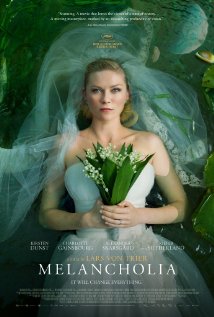
via IMDb.com

I saw Melancholia twice in theaters. The first time I saw the movie was at an artsy theater in Indianapolis. The audience was quiet, focused, and alert, absorbing all of the subtle and profound emotions portrayed by Kirsten Dunst and Charlotte Gainsbourg.

The second time was at a theater in a college town. The audience was loud, talkative, and arrogant. And they were definitely more intoxicated than the Indianapolis audience, which is weird because the artsy theater offered alcohol (and the university had a supposedly dry campus). Though, to be fair, I don’t blame the college students. If I was sporting a 1.5 GPA because of a moderate Call of Duty addiction and was going to see a movie about the slow demise of our planet, I’d probably drink too.

What intrigued me, however, was how the different audiences impacted my perception of the movie.

via IMDb.com

Before diving into that ocean of gaudy introspective self-praise, though, I need to explain a little about Melancholia. Lars von Trier‘s 2011 film is a beautiful juxtaposition of the emotional and mental struggles of two sisters and a newly discovered planet that likes to invade Earth’s personal space. Kirsten Dunst plays Justine, a personification of depression and doom. For the first half of the film, the audience watches Justine destroy her wedding bit by excruciating bit. The second half of the film follows Claire, Justine’s sister, as she tries to juggle Justine’s emotional state, a creepily quiet child, Jack Bauer, and a new planet that may end all life.

So when the booze-filled audience burped their laughs, I was surprised. Depression and interplanetary tango is not exactly comedic gold. But, in some ways, it worked. Melancholia offers a dark look at life on the edge (in more than one way), and sometimes mild laughter is a good way to deal with impending doom. Also, if good movies aren’t your preference and you get bored while watching this wonderful film, it’s sort of fun to imagine Spider-Man swooping in to save Kirsten. Or Kiefer Sutherland yelling at someone.

“Life is only on Earth. And not for long,” says Justine with tired eyes.

“Like Hell it is!” growls Jack Bauer, cocking his gun and running toward the sunset.

Lars von Trier: Director

Lars von Trier: Writer

Kirsten Dunst, Charlotte Gainsbourg, and Kiefer Sutherland: Stars

Review: Rise of the Planet of the Apes (2011)

As I left the theater after watching Rise of the Planet of the Apes, my mind was working hard. There was something about the film that remained unexplained, some undefined plot hole that overshadowed an otherwise wonderful movie. I just couldn’t think of what it was. Then my friend turned to me and asked me this question:

“Man, why does Draco hate monkeys so much?”

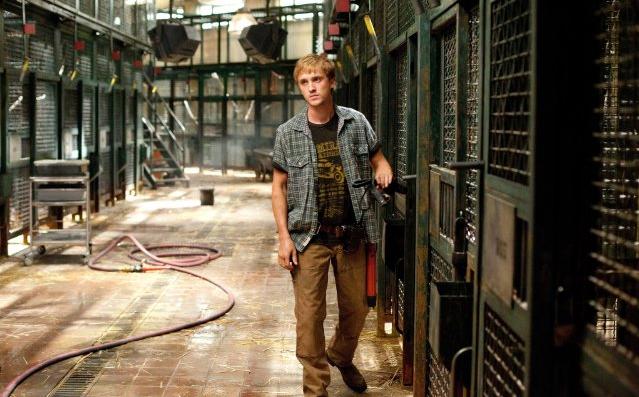
That was it! What the hell was wrong with Draco? Every time Tom Felton‘s character appeared on screen, the film took an unnecessarily dark turn. It was like a grim version of Annie, except that Miss Hannigan was a hormonal boy and the orphans were apes (which is the plot of my next Annie-inspired fan-made musical, It’s a Hard Ape Life). Tom Felton’s Ratched-like character spent every on-screen moment either antagonizing the apes (and one particularly entertaining orangutan) or showing some of his unnamed friends how awesome he looks when he commits acts of animal cruelty.

Tom Felton in Rise of the Planet of the Apes via IMDb.com

What made this character—named Dodge, for some reason—particularly troubling, though, was that he had no reason to dislike apes. At no point in the film is the audience introduced to some dark backstory or an emotional disorder that would help explain Dodge’s aggressive anti-primate behavior. Instead, the audience is left to assume that Dodge is a genuinely and unnecessarily awful human being. At least Draco Malfoy could blame his parents…and Voldemort. Dodge can only blame himself. Get him, PETA.

Reservoir Dogs (1992) and Steve Buscemi

via IMDb.com

If you’re looking for a movie about well-dressed, foul-mouthed gangsters who tell tasteless jokes and spend great amounts of time debating the finer sociological aspect of tipping at restaurants, Quentin Tarantino’s Reservoir Dogs is the movie for you. It is a simple, mobster-style movie peppered with flashbacks and gunfire. Though the plot is coated with mystery, the film plays more like a character-drama, chronicling some important moments in the lives of a few complicated individuals.

Oh, and congratulations, Steve Buscemi.

WARNING: OFFAL SPOILER ALERT

Congratulations, Steve BuscemiReservoir Dogs highlights the crazy antics of one of Buscemi’s most successful characters. In this case, “successful” refers not to the critics’ responses to Buscemi’s character but to the character’s relative success in the actual events that occur during the course of the movie. This relative success is celebration-worthy because Buscemi’s characters don’t often succeed. A Buscemi-played character is likely to become mentally unstable, mangled, or dead. Let’s look at some of Steve Buscemi’s characters:

  • Carl Showalter, Fargo (1996). A hot-tempered crook whose deranged mind has trouble processing changes to well-made plans. Deceased.
  • Rockhound, Armageddon (1998). A bizarre genius who shows no respect for the seriousness of working on an asteroid. Mentally unstable.
  • Donny KerabatsosThe Big Lebowski (1998). A curious pushover who suffers through verbal abuse and unprovoked hostility without complaint. Deceased.
  • James McCord, The Island (2005). A helpful techie whose philanthropic spirit doesn’t get to see the second half of the movie. Deceased.
  • Wiley, Grown Ups (2010). An overgrown child whose friends have little respect for his physical well-being. Mangled.

And that is just a sample. Sure, there are exceptions to this trend, but the already small list of anomalies is saturated with relatively unlikable characters like Randall Boggs from Monsters, Inc., Garland Greene from Con Air, and Clint Fitzer from I Now Pronounce You Chuck & Larry.

Of course, given the release dates of these movies, it is possible that Buscemi perfected his oddball character type after playing Mr. Pink in Reservoir Dogs. But, still, it’s comforting to know that at least a couple of Steve Buscemi’s characters had relative success in their respective universes. And it is relative success: Mr. Pink probably died.

But, of course, all of this is a testament to Buscemi’s artistic skill. His ability to consistently provide moviegoers with compelling and often comedic weirdos/sociopaths is unparalleled. Thank you, Steve Buscemi, and congratulations.

Review: Flashbacks of a Fool (2008)

via imdb.com

Flashbacks of a Fool is a coming-of-age tale about forbidden romance, teenage innocence, and the dangers of old sea mines. More importantly, it is evidence that brilliance can exist without coherence or flow.

The movie is about a struggling Hollywood star and his bizarre past. The star, played by Daniel Craig, is a promiscuous, emotionally immature has-been who discovers that a childhood friend has passed away. Instead of casually reminiscing about his childhood while relaxing on his couch or listening to Enya’s “Orinoco Flow” over and over (which is a great way to relax, by the way), Joe Scot (Craig) decides to go for a semi-drunk swim. This, of course, brings about a rather long flashback, a flashback that lasts for nearly half of the movie and includes impromptu dancing, intergenerational intercourse, and unexploded mines.

Baillie Walsh, the writer/director, guides the audience through a beautiful cacophony of settings, camera angles, and storylines without regard for context or flow. This is Walsh’s first and only feature film, but that fact didn’t seem to stop the novice director from peppering the occasionally cliché film with some beautifully absurd scenes. The film is a constant war between art and kitsch, and Walsh doesn’t seem to care which side wins. Using the flashback gimmick as a weak invisibility cloak for randomness, Walsh embraces the kitsch of his protagonist’s childhood, and that willingness to flaunt cinematic spontaneity allows Walsh to blur the lines between gaudiness and beauty. The movie’s flashback scenes, as a whole, are like the contents of a particularly unique party mix—both delicious and unnerving—and their weirdness helps explain the protagonist’s reluctance to relive his past.

Flashbacks of a Fool encourages paradoxical descriptors. It is both fascinating and dull, gaudy and beautiful, kitschy and artsy, ignorant and self-aware, easy and confusing, complicated and simple. The video below (featuring the lovely Felicity Jones) is beauty without context. When the scene first appears in the film, it seems random and spontaneous, yet it is crucial to the film’s ending. Enjoy its beauty. Embrace its absurdity.

Baillie Walsh: Director

Baille Walsh: Writer

Daniel Craig, Harry Eden, and Felicity Jones: Stars

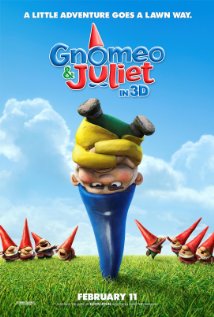
Review: Gnomeo & Juliet (2011)

via IMDB.com

Yes, I know. Kelly Asbury, director of Shrek 2, is bold for suggesting that moviegoers pay money for yet another version of Shakespeare’s famous play. For many, the majesty of the classic faded after numerous high school projects and reading quizzes. And, even if Asbury can create a respectable version of Romeo and Juliet, perhaps lawn gnomes aren’t the best vehicle, especially when compared to gritty movies like Baz Luhrmann’s Romeo + Juliet (1996) and Andrzej Bartkowiak’s Romeo Must Die (2000).

But, the crew of Gnomeo & Juliet (2011) knew all this. The film’s opening scene features a single gnome who explains that, yes, this story has been told many times before and that, yes, they are going to tell it again. But, this time, it will be different. And it is different. Never before has an adaptation of Shakespeare’s play featured the voices of Ozzy Osbourne and Hulk Hogan (for some reason). Not to mention the whole lawn gnome element.

Gnomeo & Juliet offers a pleasant and simple version of the classic play. The movie follows Shakepeare’s storyline relatively well, which is impressive given the animated cast of gnomes, clay bunnies, and plastic flamingos. Any large diversion from the original script is explained during the movie. In fact, the only questionable use of Shakespeare’s fame is the film’s portrayal of Shakespeare himself. The playwright appears as an oddly unlikable Shakepeare statue (voiced by Patrick Stewart) who, for some reason, doesn’t seem to care much about the lives of lawn gnomes.

If nothing else, the movie sounds fantastic. The smooth and upbeat music of Elton John (one of the film’s executive producers) is sprinkled with the vocal talents of James McAvoy (Gnomeo), Emily Blunt (Juliet), Michael Caine, Jim Cummings, Stephen Merchant, Maggie Smith, Jason Statham, Patrick Stewart, and Julie Walters. And, of course, Hulk Hogan, Ozzy Osbourne, and Dolly Parton lend their voices as well.

I recommend Gnomeo & Juliet. It sounds great and it looks great. The first ten minutes or so are a bit awkward and unfunny, but it’s easy enough to pass that time by counting the not-so-subtle allusions to Romeo and Juliet or counting the changes made to Elton John’s songs to better accommodate the lives of lawn ornaments. Make it a drinking game. Just don’t play in the theater.

Review: The King’s Speech (2010)

Colin Firth and Helena Bonham Carter (movie photo via Oscar.go.com)

Tom Hooper’s The King’s Speech (2010) is a delightfully inspirational and intriguing movie about stuttering, family issues, and the endearing relationship between King George VI of England and Lionel Logue. But the quality of the film is obvious. The King’s Speech received twelve Oscar nominations, seven Golden Globe nominations, four Screen Actors Guild Award nominations, and thirteen nominations from the British Academy of Film and Television Arts. The King’s Speech speaks for itself.

To add more praises for The King’s Speech to the Internet would be a waste of virtual space. So, instead, I’d like to talk about Timothy Spall. Timothy Spall‘s performance in The King’s Speech as Winston Churchill has received some criticism. Some call it Tom Hooper’s only mistake. Others consider Spall to be a poor representation of Churchill. The Guardian calls Spall a “woefully thin pastiche,” and USA Today writes, “The only weak link is Timothy Spall, miscast as Winston Churchill. It’s not clear who Spall is playing, but it doesn’t appear to be Churchill.” For those who haven’t seen The King’s Speech, here is a clip featuring Timothy Spall as Churchill.

Timothy Spall as Winston Churchill (photo via news.uk.msn.com)

I disagree with the criticism of Timothy Spall’s performance. So, to counter such criticism, I offer three arguments:

1) Churchill was an intriguing character. His cigar poses are awesome. His drunken episodes are legendary. And some of his first words as Prime Minister to the British House of Commons were “I have nothing to offer but blood, toil, tears and sweat.” Also, Churchill’s interests were as broad as his chin. He enjoyed painting and writing, and he even received the 1952 Nobel Prize in Literature. So, when critics say that Timothy Spall’s version of Churchill didn’t match the rest of the picture, they didn’t consider that perhaps that’s because Timothy Spall believes that Winston Churchill’s awesome qualities didn’t match the rest of twentieth-century Europe.

via IMDB.com

2) Who else? Some critics believe strongly that Timothy Spall was a poor choice, but I have yet to hear any feasible alternatives. Winston Churchill, though awesome, provides a unique challenge to directors who like to create semi-accurate physical portrayals of historical figures. To understand my point, consider, for a moment, some possible alternatives. Frank Langella: This lanky Churchill would be too similar to Langella’s portrayal of Nixon, and, while it may be interesting, a Nixon-infused Churchill is not what The King’s Speech needs. Alec Baldwin: Intriguing but ultimately wrong; this emotionless Churchill lacks the raw manliness of the real man. Martin Sheen: This Churchill doesn’t sound like Churchill. Bill Nighy: This Churchill has the sound and the attitude but not the look. Geoffrey Rush: Already in The King’s Speech. My conclusion is this: Timothy Spall may not be the right Churchill, but he is certainly the best.

3) Love for Peter Pettigrew. Timothy Spall has devoutly played Wormtail in every Harry Potter movie from Prisoner of Azkaban to Deathly Hallows: Part 1. That alone should earn him our love and respect.

So, The King’s Speech is a wonderful movie with well-written dialogue, excellent directing, and one stunning Winston Churchill.

Review: Exit Through the Gift Shop (2010)

Film picture via Oscar.go.com

Prior to seeing Exit Through the Gift Shop (2010), I knew very little about the world of graffiti and street art. After seeing Banky’s film, I still know little about this world, but I now have a growing appreciation for those who can climb about rooftops late at night with large sheets of personalized paper and buckets of paste. And I have an even bigger appreciation for those who can do so with grace and style.

The film outlines the evolution of Thierry Guetta (later known as Mr. Brainwash), a hopelessly enthusiastic videographer and aspiring street artist. The film’s juxtaposition of Guetta with the suave, laid-back Banksy offers viewers a comedic introduction to a number of street art subtleties, not the least of which is the existence of street art imitators. Guetta, though endearing, is (spray-)painted as a somewhat annoying copycat of established street artists such as Shepard Fairey and Banksy. After discovering the world of street art, Guetta follows Fairey, Space Invader, and others as they make and share street art. Guetta documents the entire process, occasionally offering odd commentaries to otherwise stunning scenes. Guetta later tries his hand at beautifying cities with his own street art and eventually hosts his own high-profile art show as Mr. Brainwash. The transformation of Thierry Guetta into Mr. Brainwash challenges many assumptions about art and graffiti. Even Banksy himself wonders aloud (with perfect comedic timing) if art is truly accessible: “I used to encourage everyone I knew to make art; I don’t do that anymore.”

Exit Through the Gift Shop via IMDB.com

Some speculate that Exit Through the Gift Shop is another elaborate Banksy hoax. Perhaps Banksy hired Thierry Guetta. Or, maybe, Guetta and Banksy are one and the same. As a recent convert to the wonders of street art, including the works and character of Bansky, I have no guess as to how the film came to be. Hoax or not, Banksy’s film is wickedly entertaining and offers a commentary on some genuine issues within the world of street art. The film, despite its aggressive satire, is surprisingly inspirational. Were my drawings anything more than oddly high-brow stick figures, I’d be tempted to share them with the world. For those, like me, who don’t have great artistic abilities, Exit Through the Gift Shop is an entertaining reminder that beauty can be found (and put) anywhere. Amidst this often misunderstood counter-cultural movement, true art can emerge.

Exit Through the Gift Shop, Banksy’s directorial debut, received a Oscar nomination in the Documentary Feature category, and Banksy was nominated for an award from the British Academy of Film and Television Arts (BAFTA) for Outstanding Debut by a British Writer, Director or Producer. In the Oscar race, I’m rooting for Exit Through the Gift Shop. I have nothing against the other Documentary Feature nominees (Gasland, Inside Job, Restrepo, and Waste Land), but I’m curious if Banksy would show up to accept his award.